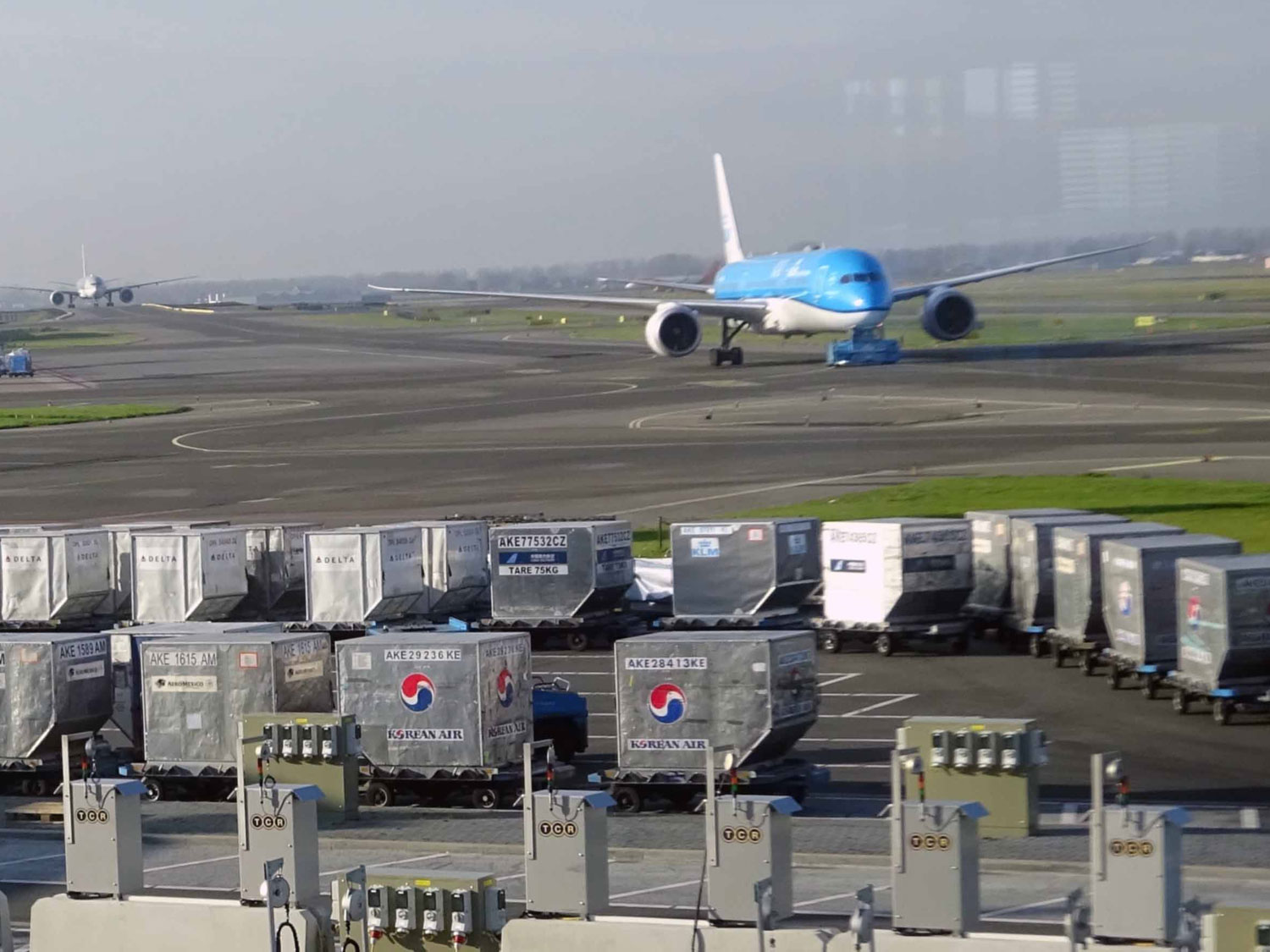
ULD on tarmac

Front‑Loading and Hidden Inventory Disrupt Traditional Peak Season

The traditional second‑half transpacific cargo peak is unlikely to materialise this year as a wave of accelerated shipments in the first half of 2025 has drained demand from the later months, while significant volumes of hidden inventory remain stalled in supply chains.

In the first half of 2025, shippers brought forward large volumes of cargo in anticipation of increasing tariffs later in the year. This front‑loading intensified in May and June, particularly on Asia–US West Coast and East Coast routes. By July and August, the usual third‑quarter build‑up failed to materialise, with demand easing as warehouses filled with earlier‑delivered stock. Through August and September, significant volumes remained stored in bonded facilities and regional hubs across the US, delaying their movement into end‑markets.

US importers are taking a cautious stance, with many shifting to calling-off or ordering only what is immediately required, adopting a “wait‑and‑see” approach in response to ongoing uncertainty over the US economic outlook and potential trade policy shifts.

Hidden Inventory Dampens Air Cargo Flow
The holding back of cargo is affecting airfreight patterns. Instead of moving directly to consignees, goods are being held at warehouses, hubs and terminals throughout the supply chain, often without showing on anyone’s dashboard. This “hidden inventory” keeps spot demand artificially subdued while preventing a normal seasonal rate drop.

As a result, air cargo rates may remain supported and despite signs of a cooling demand environment. Market turnover is slowed, with more tariff turmoil pushing the impact of inventory release further into the year.

With peak volumes shifted earlier in the year, the traditional seasonal curve has flattened, making weaker‑than‑usual cargo surges likely in the third and fourth quarters. This shift creates capacity planning challenges for carriers that had anticipated a late‑summer rush, potentially leading to under‑utilised sailings or the need to adjust service rotations. At the same time, US importers are taking a cautious approach, placing smaller and more frequent orders while deferring larger commitments until there is greater certainty over the economic outlook and future trade policy.

Until the hidden stock is released and importers regain confidence, the transpacific market is unlikely to see the kind of seasonal uplift typical in past years. Both ocean and air freight providers may need to adapt to a longer‑than‑expected period of muted demand through the remainder of 2025.

Metro’s dedicated air freight team and expanding U.S. presence help shippers navigate shifting transpacific flows with confidence. From capacity management and efficient routing to agile supply chain control and inventory visibility, we keep your air cargo moving smoothly across the Pacific.

Email Managing Director, Andy Smith, to learn more.

LAX 1440x1080 1

Transatlantic Air Cargo: Calm Surface, Hidden Currents

The transatlantic air cargo market may appear steady, with stable capacity and rates, but beneath this surface calm, subtle shifts are reshaping flows, costs, and opportunities, especially on niche routes like Canada–Europe and Mexico–Europe.

While wide-body and freighter capacity from Europe to North America has edged up around 2% so far this year, the opposite direction has slipped by about 1%. Recent months, however, reveal sharp month-on-month jumps, with capacity from Canada to Europe up 14%, and Europe to Canada up 16%. Airlines like Air Canada and Air France-KLM have expanded significantly, while others have held or slightly reduced services.

The capacity surge on Canada–Europe routes coincides with the summer holiday season, boosting passenger belly-hold space. But freight data points to something more: flown tonnages from Europe to Canada jumped around 10% in early July compared with the previous three weeks, though without a corresponding rise in average rates…yet.

On the pricing front, the top end of spot rates between Canada and the UK nearly doubled at the end of June, while France–Canada rates also climbed sharply. Strengthening UK–Canada trade ties, including the UK’s accession to the Comprehensive and Progressive Agreement for Trans-Pacific Partnership (CPTPP), are likely adding further momentum, potentially lifting logistics demand across both ocean and air freight.

Elsewhere, European exporters have seen steady or rising air cargo flows to North America:

Italy has boosted air exports to the US by over one-third, focusing on fashion goods.
France has lifted exports by nearly half, driven by luxury and pharmaceuticals.
Norway fish exports to the US have surged over 50%.
Ireland, concerned about possible US tariffs on pharmaceuticals, has seen air rates to the US climb since May, with sharper increases in July.

Softening Signs, But Cautious Optimism
Overall, transatlantic rates have eased with the arrival of summer and additional belly capacity, particularly on mainline Europe–US routes. Expect stable or slightly reduced spot pricing, typical for this seasonal slack period. However, some airlines are expressing optimism for the second half, buoyed by promising early signals from peak season negotiations.

A delayed US tariff deadline (now 1 August) and new trade measures affecting partners like Japan and South Korea could prompt a short-term wave of airfreight “front-loading.” Longer-term, shifting freighter capacity from Pacific routes toward the transatlantic may rebalance the market, while the removal of US de minimis import exemptions will reshape eCommerce flows into the US.

While today’s transatlantic air cargo market may seem subdued, pockets of demand and policy uncertainty are quietly stirring the waters. Shippers need to be agile to capture emerging opportunities and be prepared for the unexpected.

Metro’s dedicated air freight team and expanding U.S. presence help shippers navigate shifting transatlantic flows with confidence. From capacity management and multimodal routing, to agile supply chain management and inventory visibility, we keep your air cargo moving smoothly — across the Atlantic and around the world. EMAIL our Managing Director, Andy Smith, to learn more.

LHR BA landing

Preparing for Air Cargo Peak Season Amid Tariff Uncertainty

Air freight markets are entering the second half of 2025 in a state of volatility, as early signs of peak season demand clash with consumer caution and a shifting tariff landscape.

Despite President Trump suggesting that the next round of US tariffs may not take effect until August, the legal reality is firmer: the executive order issued on 9 April mandates that reciprocal tariffs will be enforced from 12:01 am EDT on 9 July, unless a further Executive Order is made. This deadline is already influencing behaviour across key trade routes and sectors, with shippers attempting to front-load freight and adjust their sourcing strategies.

As expected, June saw a seasonal lull across many air freight corridors. Rates out of Hong Kong to both Europe and North America softened slightly month-on-month, falling by low single digits, while year-on-year declines were sharper to North America, reflecting weaker consumer demand and reduced eCommerce.

The removal of de minimis exemptions combined with the imposition of tariffs on many goods, has triggered a pronounced shift in flows: air cargo volumes from China to the US have fallen around 15% since March, while rates have dropped by more than 15% over the same period. In contrast, tonnage from China to Europe is up 15% year-on-year, supported by stable rates and reallocated capacity.

Transatlantic lanes also reflect the summer dynamic. With increased belly-hold capacity from passenger flights, rates between Europe and North America dipped slightly in June. However, spot freight prices on both directions of the transatlantic remain higher than a year ago, suggesting underlying resilience.

Spot Market Dominance and Capacity Volatility
One of the most significant developments this quarter has been the dramatic shift toward the spot market on Asia Pacific–US lanes. By June, more than 70% of general cargo bookings on these routes were made on spot terms, up from around 50% in the same period last year. This trend reflects carrier uncertainty, volatile demand, and diverging expectations around tariff timing and impact.

For comparison, spot market activity on Asia-Europe lanes has remained relatively stable, with roughly 47% of cargo moving under short-term rates. The growing disparity between contract and spot pricing points to the challenges of forecasting capacity needs in politically sensitive markets.

Peak Season Prospects: Uncertainty Over Tradition
Traditionally, air freight demand accelerates from mid-August as retailers ramp up inventory for back-to-school, autumn sales, and the holiday period. However, the current market is anything but traditional. Consumer confidence remains fragile due to rising living costs and trade friction, with the largest shippers increasingly hesitant to commit to long-term air freight contracts.

Global air cargo volumes rose by just 1% year-on-year in June, with capacity growth outpacing demand for the first time in over 18 months. This imbalance is likely to pressure rates across many lanes, even as jet fuel prices spike and geopolitical risks persist.

While some Southeast Asia–US routes saw modest rate gains in June, buoyed by pre-tariff demand and capacity rebalancing, overall expectations for Q3 remain muted. Analysts warn that weaker consumer spending and ongoing tariff complications could limit any meaningful peak season surge, especially on transpacific routes.

Outlook 
Despite the structural pressures, there are opportunities for shippers in the current environment. Short-term rates are more flexible, capacity is more available than in past peak seasons, and carriers are actively repositioning services to match evolving demand patterns.

The real wildcard remains US trade policy. Without a new executive order, 9 July marks the start of a new tariff chapter that will ripple across global supply chains, just as the air freight industry typically gears up for its busiest season.

Now is the time to plan ahead.
With more flexible short-term rates, improved capacity availability, and carriers adapting to demand shifts, shippers have a unique window to secure cost-effective and reliable air freight solutions before peak season pressure builds.

EMAIL our managing director, Andrew Smith today to assess your options and take advantage of current market conditions.

Dubai

Middle East Air Freight Disruption Despite Partial Recovery

Qatar Airways has resumed operations from Doha following a temporary airspace closure triggered by Iranian missile attacks on US bases in Qatar and Iraq. The reopening has offered some relief, but flight schedules remain heavily disrupted, and wider instability across the Middle East continues to affect air freight flows.

The recent hostilities briefly grounded flights from Doha and contributed to a fresh wave of cancellations across the region, just days after US airstrikes on Iranian nuclear facilities escalated the conflict. Although a short-lived ceasefire between Iran and Israel allowed for a partial resumption of services, tensions have reignited, forcing airlines and cargo operators to remain cautious.

Qatari airspace reopened in the early hours, but Qatar Airways warned of significant delays as flights resumed and schedules were rebuilt. Meanwhile, Emirates SkyCargo confirmed it has begun uplifting additional fuel on flights from Dubai to allow for longer rerouting — a measure that could reduce payload and force the offloading of some shipments.

Despite these challenges, cargo operations in the region have proven relatively resilient. From Saturday to Monday, around 13,000 tonnes of air freight moved from the Middle East to Europe, only slightly down from early June levels. Capacity from Asia Pacific into the Middle East has even increased over the same period, climbing to 18,000 tonnes.

Airline Suspensions and Reroutes Continue
Passenger services, many of which carry belly-hold cargo, remain widely impacted. Airlines including British Airways, Air France KLM, Singapore Airlines, United Airlines, American Airlines, Air Canada, Finnair, and Air Astana have cancelled or suspended flights to key Gulf hubs such as Dubai, Doha, and Riyadh. Flights to Israel, Iraq, Iran, Lebanon, Jordan, and Syria also remain suspended due to the continuing risk.

Flight tracking data confirms extensive rerouting around Iranian and Iraqi airspace. Empty corridors now dominate the skies over key parts of the Middle East, with many services opting for longer paths via Egypt, Saudi Arabia, or the Caspian region adding time, fuel cost, and operational complexity.

While the overall air freight network remains intact, the situation is highly volatile. The risk of sudden airspace closures, GPS interference, and further retaliatory strikes remains high, particularly for carriers linked to the United States. Capacity constraints, schedule delays, and routing inefficiencies may persist until regional tensions ease.

We’re actively monitoring events, adjusting routings, and working with trusted partners to safeguard your shipments. If your supply chain is exposed to disruption in the Middle East, EMAIL our managing director, Andrew Smith, for clear advice and fast solutions.