steel in car manufacturing

UK steel tariff changes reshape import costs

The UK’s incoming steel trade measures are set to reshape import dynamics almost overnight, with significant cost and compliance implications for manufacturers, construction firms, and industrial supply chains.

From 1 July 2026, the UK will replace its current steel safeguards with a far more restrictive tariff rate quota (TRQ) system. Tariff-free quotas will be cut by around 60% overall, with some key product categories seeing reductions of up to 90%. At the same time, the duty applied to volumes above quota will double to 50%.

The measures apply across approximately 20 steel product categories, including flat products, bars, and pipes, and notably apply regardless of origin, including imports from EU and other trade agreement partners.

While positioned as a move to protect domestic steel production, the reality for importers is a much tighter and more punitive operating environment.

Why this matters for importers

For UK businesses reliant on imported steel, including automotive, machinery, construction, and engineering, the changes introduce both immediate cost risk and ongoing supply uncertainty.

The most significant shift is how quickly quotas are expected to be exhausted. With volumes sharply reduced, many categories could run out within days or weeks of each quarter opening, rather than lasting the full period. Once quotas are filled, any additional imports will face a 50% duty, creating a substantial and potentially unmanageable cost increase.

At the same time, domestic supply is unlikely to fill the gap. Many manufacturers rely on specific grades or forms of steel that are not readily available in the UK, meaning substitution is not always viable.

Rising costs and supply chain pressure

Industry bodies are already warning of widespread disruption. Higher input costs are expected to ripple through supply chains, increasing production costs and reducing competitiveness for UK manufacturers.

There is also growing concern around material availability. In sectors such as construction, limited domestic capacity combined with tighter import restrictions could lead to shortages of key products, delaying projects and adding further cost pressure.

For exporters, the impact is twofold: higher input costs at home and increased competition from overseas producers who are not subject to the same tariff burden.

Operational complexity increases

Beyond cost, the new regime introduces a more complex and time-sensitive import process.

The TRQ system will continue to operate on a first-come, first-served basis, with quarterly allocations managed through HMRC. This puts significant pressure on timing, both in terms of shipment planning and customs entry.

If a shipment is declared after a quota has been exhausted, it will immediately fall into the higher duty bracket, regardless of when it was shipped. This makes accurate forecasting, documentation, and coordination between supply chain partners critical.

Importers will need to pay close attention to:

  • Entry timing versus quota availability.
  • Correct tariff classification and documentation.
  • Coordination between forwarders, brokers, and internal teams.
  • Monitoring quota usage in near real time.

Even small missteps could result in substantial, avoidable duty exposure.

Behavioural shifts already underway

In response, many importers are already adjusting their strategies. There are signs of front-loading shipments ahead of the July deadline, alongside contingency planning based on higher landed cost scenarios.

Some businesses are modelling worst-case pricing as a baseline, while others are reviewing sourcing strategies or considering inventory increases to mitigate risk.

However, these are short-term responses. Longer term, the market may see shifts in sourcing patterns, pricing structures, and even production locations if cost pressures 

persist.

With additional measures such as the UK’s Carbon Border Adjustment Mechanism (CBAM) due to follow in 2027, importers face a longer-term trajectory of rising complexity and cost.

The new steel regime will penalise those who don’t plan ahead and prepare. Metro’s customs and compliance experts are already supporting clients with quota planning, tariff classification, and import strategy to minimise risk and control costs.

For tailored guidance on how these changes will affect your business, EMAIL Andy Fitchett, Metro’s Head of Customs & Compliance.

Investigation

US Customs and Border Protection to target undervaluation and DDP abuse

President Trump’s new customs enforcement drive is turning DDP and other seller‑controlled models into a high‑risk area, especially where duties are undervalued or the true importer of record is unclear.

The 3 June 2026 “Strengthening Customs Enforcement” executive order marks a significant tightening of how US Customs and Border Protection (CBP) vets and polices importers of record. It directs CBP to raise minimum asset and bond requirements, collect more detailed data at registration, and classify importers into risk‑based tiers linked to their compliance history.

Importers will have to disclose anticipated import volumes, beneficial ownership, business affiliations and domestic assets, and maintain a defined “good standing” status to continue importing or appointing a customs broker. Foreign‑based importers face additional restrictions, including limits on informal entries and tighter conditions for using continuous bonds.

Why DDP and DAP are in the spotlight

Higher tariffs in Trump’s second term have nudged contract terms towards Delivered Duty Paid (DDP) and similar structures, where the seller takes responsibility for duties, taxes and customs clearance. On paper, this can simplify life for buyers, but it also shifts control of declarations and valuations to the party with the strongest incentive to cut landed costs.

CBP has highlighted undervaluation, mis-declaration and opaque importer structures as priority enforcement areas. In a DDP or DAP model with a foreign importer of record, there is a heightened risk that declared values are artificially low, classification is aggressive, or the nominal importer is a thinly capitalised shell with few US assets. These are exactly the patterns the new regime is designed to catch.

Delivered Duty Paid arrangements often rely on overseas documentation and invoicing that CBP cannot easily verify at the border. Low‑value or informal entries have historically been harder to police, and this has created room for abuse, such as splitting shipments, manipulating invoice values or using rebates that never appear on the customs invoice.

Under the new enforcement approach, CBP is explicitly targeting misclassification, undervaluation and duty‑avoidance schemes. With higher tariffs in play, the financial upside of under‑declaring value is greater, but so is the downside: higher penalty floors, fewer mitigation options, and an increased likelihood of audits, holds, and retrospective assessments if patterns look suspicious.

Foreign IORs and “shell” structures

The executive order draws a sharper distinction between US and foreign importers of record, and seeks to close loopholes that have allowed foreign entities to mimic US presence using shell companies. To qualify as a US importer, entities will need a genuine US footprint: incorporation under US law, a principal place of business in the US, tangible domestic assets and identifiable US beneficial owners.

Foreign IORs will be barred from using informal entries and will face stricter bond and vetting requirements for formal entries, often needing validation via trusted trader programmes or a validated US customs broker. This makes it more difficult for lightly capitalised overseas sellers to hide behind complex structures when operating DDP models into the US.

Higher penalties, more data, more audits

The enforcement framework is also being hardened across the board. CBP is moving to set minimum penalty and liquidated damages floors, reduce mitigation options, particularly for repeat offenders, and expand the use of audits and data‑driven targeting. Brokers that turn a blind eye to high‑risk clients, or fail to exercise due diligence, can expect higher penalties and closer scrutiny.

Importers will be required to submit additional documentation, including the same export paperwork filed with the foreign customs authority, supply chain certifications and more detailed product specifications. This expanded dataset supports CBP’s increasing use of analytics and AI to flag unusual trade patterns, valuation anomalies, and sudden shifts in importer or routing behaviour.

If your US trade relies on DDP, DAP or foreign importer‑of‑record models, this new enforcement environment demands a fresh look at your structures, contracts and declarations before CBP does it for you.

To review your current arrangements, assess your exposure and design a compliant, resilient approach to US customs under the new rules, please EMAIL Andy Fitchett, Metro’s Head of Customs & Compliance.

EU UK negotiations 2

UK–EU reset could ease border friction for importers and exporters

On 13 May 2026, the King's Speech set out the government's plans for the next Parliamentary session, including efforts to reset post-Brexit relations, forge closer economic ties with the EU and reduce unnecessary barriers to trade.

The reset is not a return to the single market or customs union. Instead, it is being presented as a targeted attempt to stabilise the trading relationship through closer alignment in specific areas where the government believes reduced friction could support growth, cut costs and improve supply chain efficiency. 

SPS alignment could simplify GB–EU border processes

The government intends to pass legislation by the end of 2026 to enable an SPS agreement with the EU to take effect by mid-2027. The agreement would cover animal and plant health, food safety and related agri-food rules, with the UK aligning to relevant EU legislation in order to ease border procedures.

SPS controls have been among the most disruptive post-Brexit trade barriers, creating additional documentation, inspection, certification and timing challenges at the GB–EU border.

A veterinary-style agreement could reduce the need for some routine checks and help make border movements more predictable. For exporters, this may improve access into EU markets. For importers, it could reduce delays, compliance costs and uncertainty when bringing goods into Great Britain.

Emissions trading alignment could reshape supply chain costs

Alongside the SPS agreement, the government is also negotiating closer alignment between the UK and EU emissions trading schemes (ETS), designed to reduce regulatory divergence and support longer-term industrial and energy cooperation. 

For businesses involved in manufacturing, energy-intensive production, transport and international trade, the implications could extend well beyond environmental policy.

A linked or more closely aligned ETS framework could help reduce friction for exporters trading into Europe, particularly as the EU continues expanding carbon-related trade measures and compliance requirements. It may also provide greater long-term certainty for businesses operating across both UK and EU markets.

Dynamic alignment brings certainty but also new compliance considerations

The proposed reset relies on dynamic alignment in selected areas, meaning UK rules would keep pace with relevant EU law as it evolves. This is central to the government’s ambition to reduce border friction, because smoother trade processes depend on both sides recognising equivalent standards.

For logistics and supply chain teams, this could provide greater medium-term certainty over the regulatory framework affecting GB–EU trade. However, it also means businesses will need to monitor changes in EU rules that may flow into UK requirements over time.

The wider political debate remains active. Critics argue that dynamic alignment could reduce UK regulatory flexibility, while others want the government to go further and pursue a customs union. 

What this means for UK traders

The direction of travel may point toward a less burdensome GB–EU trading environment, but the more realistic reading is:

  • Customs declarations are not going away simply because an SPS deal is agreed.
  • Rules of origin issues are not being removed by the reset as described in this briefing.
  • What may improve is the regulatory layer sitting on top of customs processes for certain categories of goods, especially agri-food.

That distinction matters, because a truck can still need customs processing even if SPS checks become lighter or less frequent.

So the likely benefit is not “no border”, but a border with fewer SPS-related interruptions, fewer compliance mismatches and a lower chance that a shipment is delayed because UK and EU technical rules have drifted apart.

Importers and exporters should now review where SPS controls, border checks, certification or documentary requirements are creating cost, delay or uncertainty in their supply chains. They should also assess whether current customs and compliance processes are flexible enough to adapt as the UK–EU framework develops.

As the UK–EU reset develops, Metro is helping customers assess how changing customs procedures, SPS requirements and evolving regulatory alignment could affect their supply chains, transit times and compliance obligations. 

Through integrated freight forwarding, customs support and cross-border logistics expertise, Metro helps businesses prepare for changing GB–EU trade conditions and maintain efficient cargo flow across European supply chains.

EMAIL Managing Director, Andrew Smith, today to learn more.

HKG port

Peak season uncertainty grows as shippers front-load inventory and freight demand diverges

Container shipping markets appear to be entering an earlier and increasingly fragmented peak season, as geopolitical disruption, rising fuel costs and tighter carrier capacity management reshape freight demand across major trade lanes.

Bookings on several east-west corridors strengthened earlier than normal during May, with carriers maintaining upward pressure on rates as many importers accelerate shipments ahead of the traditional third-quarter peak season period.

Spot rates on Asia–US west coast services have continued to outperform other major trades, rising around 4% week on week and remaining significantly above levels seen before the escalation of Middle East disruption. Asia–Europe pricing has also strengthened modestly, with rates to North Europe and the Mediterranean increasing as carriers attempt to restore margins through capacity reductions and surcharge increases.

However, broader market conditions remain difficult to interpret. What appears to be an early peak season may ultimately reflect precautionary inventory positioning and front-loading activity rather than sustained end-user demand growth.

Front-loading and disruption are reshaping traditional shipping patterns

A growing number of importers are moving cargo earlier amid concerns that operational disruption, congestion and capacity shortages could intensify later in the year.

The continuing closure and instability surrounding the Strait of Hormuz is adding further pressure to global freight markets, with around 1.5% of global shipping capacity estimated to be affected directly by disruption linked to the region.

At the same time, higher oil prices are increasing carrier operating costs across both ocean and airfreight markets, while blank sailings are continuing to tighten effective capacity on key trades.

Capacity reductions on Asia–Europe services have become increasingly aggressive in recent weeks, with shipping lines reducing available space to North Europe and the Mediterranean while also introducing additional blank sailings beyond traditional holiday periods.

The result is a more volatile market where shipment rollovers, reduced allocations and short-notice schedule changes are becoming increasingly common, even where bookings are technically available.

On transpacific trades, carriers have also maintained relatively firm control over available capacity following post-Lunar New Year service adjustments, helping sustain pricing despite ongoing uncertainty around underlying consumer demand.

Additional surcharges introduced on Asia–US services suggest carriers expect demand to remain comparatively elevated through the summer period.

Many importers remain cautious about underlying demand, particularly in Europe where economic conditions remain comparatively weak and pressure on household spending continues to affect purchasing behaviour.

This creates the possibility that some businesses could be holding elevated inventory levels later in the year, potentially resulting in a delayed, compressed or weaker traditional peak season across certain sectors.

Metro survey highlights cautious but stable demand expectations

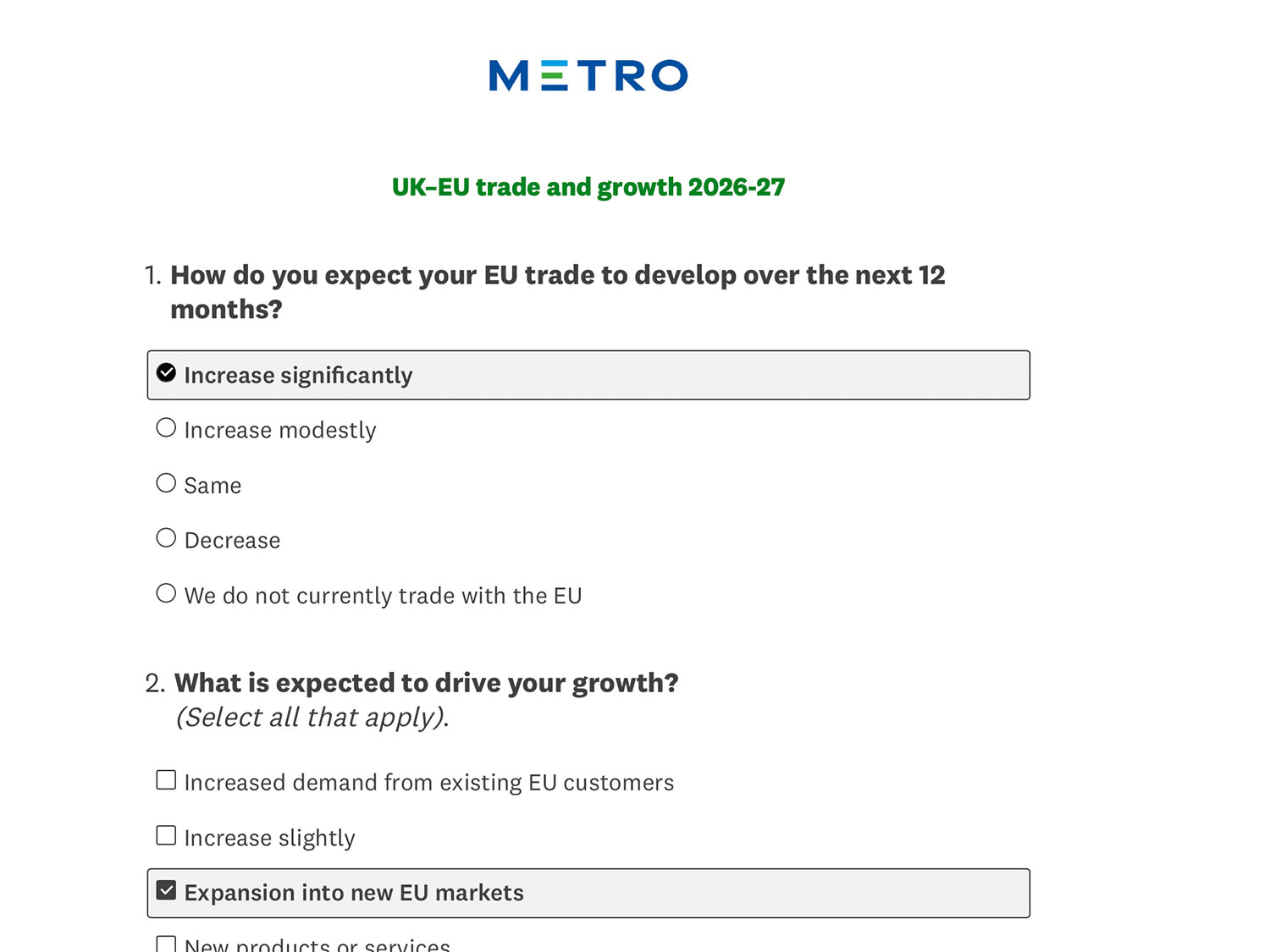
Early findings from Metro’s ongoing customer survey reflect this more balanced outlook.

Around 38% of respondents currently expect freight volumes to remain broadly stable over the next 12 months, while a similar percentage expect volumes to increase slightly. Less than 1/8 anticipate a significant decrease, while none expect a significant increase in activity.

The findings suggest that many businesses are not currently anticipating a dramatic peak season surge, but instead expect relatively stable trading conditions alongside continued disruption and cost pressure.

At the same time, respondents indicate that ongoing instability across global supply chains is continuing to influence inventory planning, shipping schedules and freight costs.

The divergence between Asia–US west coast and Asia–Europe markets highlights how uneven global freight conditions have become. Rather than moving in a single direction, pricing and demand are increasingly being shaped by regional economic performance, inventory strategies and trade lane-specific operational risks.

Sea–air solutions gaining attention as airfreight costs surge

The disruption is also influencing modal shift decisions.

With the average airfreight rate out of Asia-Pacific over 40% higher than last year shippers are increasingly exploring sea–air solutions to balance cost, speed and reliability.

Airfreight rates have risen sharply as fuel surcharges, restricted airspace and tighter capacity continue to affect global networks. At the same time, ongoing Red Sea diversions are keeping some ocean transit times above 50 days on Asia–Europe services.

For many retail, fashion, e-commerce and consumer goods shippers, sea–air services are becoming an increasingly valuable tactical solution where traditional airfreight costs are difficult to absorb but ocean transit times remain commercially challenging.

For shippers, the key challenge may now be timing. If front-loading activity continues through the early summer period, demand on some corridors could remain firmer for longer than normally expected. However, weaker consumer demand and elevated inventory levels could also limit the scale of any traditional late summer or autumn rebound.

Metro’s survey remains open, and businesses are encouraged to share their expectations and experiences, together with insights into current market conditions, operational pressures and changing supply chain requirements. The survey also provides an opportunity for customers to share feedback on Metro’s performance and highlight where additional support or solutions could help strengthen supply chain operations. 

Through proactive capacity planning, multimodal air, sea and sea-air routing options and contingency-focused supply chain support, Metro helps customers respond more effectively to disruption, changing demand patterns and ongoing peak season uncertainty. EMAIL Managing Director, Andrew Smith, to learn more.