car mirror 1440x1080 1

2024: Reflecting on a Dynamic Year in Global Supply Chains

As 2024 comes to an end, we look back at a year filled with extraordinary events that shaped the global supply chain landscape. From geopolitical challenges to shifts in logistics trends, the past year has underscored the importance of resilience, adaptability, and innovation in our industry.

Here are just a few of the major supply chain developments we covered and that defined 2024:

Houthi attacks in the Red Sea: The crisis continues, forcing vessels to divert around the southern tip of Africa, creating new delays and challenges for global trade.

Global RoRo capacity shortages: The shipping of automobiles was heavily impacted as carriers grappled with fleet reductions from the pandemic.

Labour unrest: Strikes surged 42% year-over-year, including a six-week standstill at the Ports of Los Angeles and Long Beach.

Port of Baltimore closure: The collision and collapse of the Francis Scott Key Bridge caused a three-month disruption.

eCommerce growth: Air freight demand soared on Asia-North America lanes as online shopping reached new heights.

ILA strike: A three-day US East Coast dockworker strike in October highlighted ongoing tensions over automation, with another strike looming in January 2025.

Global reefer shortages: The demand for refrigerated containers remains unmet, impacting perishable goods transport.

Political shifts: The re-election of Donald Trump signals potential changes in trade policies, with protectionism and tariffs on the horizon.

Shipping alliances: New alliances reshaped container shipping routes, including Maersk’s departure from Felixstowe.

Metro’s Highlights

2024 was also a year of achievements for Metro Shipping:

Air Freight Business of the Year: We were proud to receive this accolade at the Logistics UK Awards.

Road freight expansion: Our growing road freight division continues to support our clients’ evolving needs.

Publishing sector portfolio launch: We introduced tailored logistics solutions for the publishing industry.

Great Place to Work: Metro was officially accredited, reflecting our commitment to a positive and empowering workplace culture.

As we get ready to step into 2025, we are prepared to face challenges head-on, supporting our customers with expert insights, seamless operations, and innovative solutions.

Thank you for your trust and partnership in 2024.

Wishing you a wonderful holiday season and a successful year ahead.

Year of the Snake 1440x1080 1

Preparing for Chinese New Year: Avoiding supply chain disruption in 2025

Chinese New Year (CNY) is a time of celebration across China but presents significant challenges for shippers and careful planning is essential to navigate the disruption effectively.

In 2025, the holiday officially runs from 29th January to 4th February, with its effects on production and logistics stretching weeks before and after these dates.

Production and logistics in China begin slowing well before the official holiday period. Workers start taking leave in early January, significantly reducing manufacturing output by mid-month. During the official CNY public holidays, factories, ports, and freight services shut down entirely. Although operations resume after the Lantern Festival on 12th February, it can take until mid-March for production and shipping networks to return to normal capacity.

This extended downtime creates a ripple effect across industries dependent on Chinese manufacturing, including electronics, textiles, toys, and automotive parts. The period is characterised by delayed production schedules, increased freight costs, and severe supply chain bottlenecks.

Key challenges during CNY
1. Severe delays: Factory closures lead to delayed production and delivery schedules, particularly for industries with complex supply chains.

2. Increased costs: Freight rates spike before the holiday due to high demand, often including peak season surcharges. Post-CNY, container shortages and port congestion further inflate costs.

3. Labour shortages: Even after the holiday ends, the staggered return of workers impacts production capacity, causing additional delays.

4. Inventory challenges: Businesses relying on “just-in-time” manufacturing face stock shortages as lead times lengthen significantly.

Mitigation strategies for businesses
To minimise disruption, businesses must adopt proactive strategies to maintain continuity during and after the CNY period.

Plan shipments early: Secure carrier bookings well in advance to avoid delays or last-minute surcharges. Less-than-container loads (LCL) can offer flexibility if full container capacity is unavailable.

Diversify suppliers and routes: Reduce dependency on single suppliers or ports. Consider alternative shipping methods, such as air freight, to mitigate delays.

Optimise inventory management: Build up stock levels for high-demand products before January to account for production slowdowns.

Enhance communication: Collaborate with suppliers, logistics providers, and customers to align timelines and contingency plans. Clear communication ensures all parties are prepared for potential delays.

Post-holiday recovery: Prepare for a gradual return to normalcy by staggering production schedules and allocating resources to handle delayed shipments.

Key dates to consider
22nd January to 9th February 2025: Potential for reduced production.
29th January to 4th February 2025: Official public holidays.
12th February 2025: Lantern Festival; operations typically resume.

Metro’s proactive strategies, powered by our advanced MVT technology, keep your supply chain running smoothly during Chinese New Year.

With our MVT technology, vendor management is seamless and fully transparent down to SKU level. This powerful tool empowers you to monitor every milestone in your supply chain, enabling timely and informed decisions to effectively navigate challenges.

Chinese New Year doesn’t have to disrupt your operations. With Metro’s expertise, global partnerships, and cutting-edge MVT technology, you can avoid delays, optimise costs, and maintain critical inventory levels.

EMAIL Andrew Smith, Chief Commercial Officer, today to discover how Metro can support your supply chain through Chinese New Year 2025.

FTSE 1440x1080 1

FTSE 100 firms identify supply chain threats as a principal risk

A recent study by the Boston Consulting Group, reveals that 72% of FTSE 100 companies now identify supply chain threats as a principal risk to their operations.

This heightened concern follows significant disruptions such as the Suez Canal blockage, the COVID-19 pandemic, and the Red Sea shipping crisis, which have exposed vulnerabilities in global supply chains.

Despite widespread acknowledgment of these risks, only 54 of the FTSE 100 companies have provided shareholders with detailed information on their mitigation strategies. This lack of transparency underscores the need for more robust communication regarding risk management practices.

To address these challenges, companies are implementing various strategies:

  • Supplier engagement: Regular meetings with suppliers to monitor and share potential risks.
  • Risk documentation: Compiling and updating ‘risk registers’ to document supplier-specific risks.
  • Inventory management: Maintaining higher levels of ‘buffer’ stock to mitigate short-term crises.
  • Diversification: Expanding supply chain streams to prevent business interruptions.

Technological solutions are also being leveraged to enhance resilience. Companies are implementing robust cybersecurity measures, utilising artificial intelligence for supply chain design and monitoring, deploying algorithms to identify high-risk raw materials, and conducting comprehensive assessments of suppliers’ financial resilience and infrastructure.

Supply chain risks have now reached the boardroom, with discussions taking place within executive and audit committees. This elevation in priority reflects the critical importance of supply chain stability to overall business operations.

The findings emphasise the necessity for businesses to prioritise transparency, technological innovation, and strategic planning in their supply chain management. As risks continue to evolve, proactive risk management has become a vital component of corporate governance.

Metro’s advanced supply chain technology

Metro’s proprietary cutting-edge supply chain technology has been conceived and designed to enhance visibility, control, and efficiency. The AI-driven solutions provide real-time insights into supply chain operations, enabling companies to anticipate disruptions and respond swiftly. Features include comprehensive purchase order management, multi-modal track and trace capabilities, and consignment management tools. Additionally, the MVT ECO platform allows shippers to forecast, measure, and offset global supply chain emissions, supporting sustainability goals. By integrating these technologies, businesses can strengthen their supply chain resilience and maintain operational continuity in an increasingly complex global environment.

Metro is leading the industry in developing the technologies and platforms that simplify and support the development of resilient, agile and adaptable supply chains.

Visibility, control, environmental, and customs modules, blend together with integrations of critical digital trade documents, to provide an unparalleled supply chain platform.

EMAIL Ian Powell for further Information on our digital capabilities and how we can protect and enhance your global trade and business growth ambitions.

Customs declaration

November 2024; Customs and compliance update

Our customs consultancy team provide insights on the latest changes, making it easier for you to stay on top of your planning and development needs.

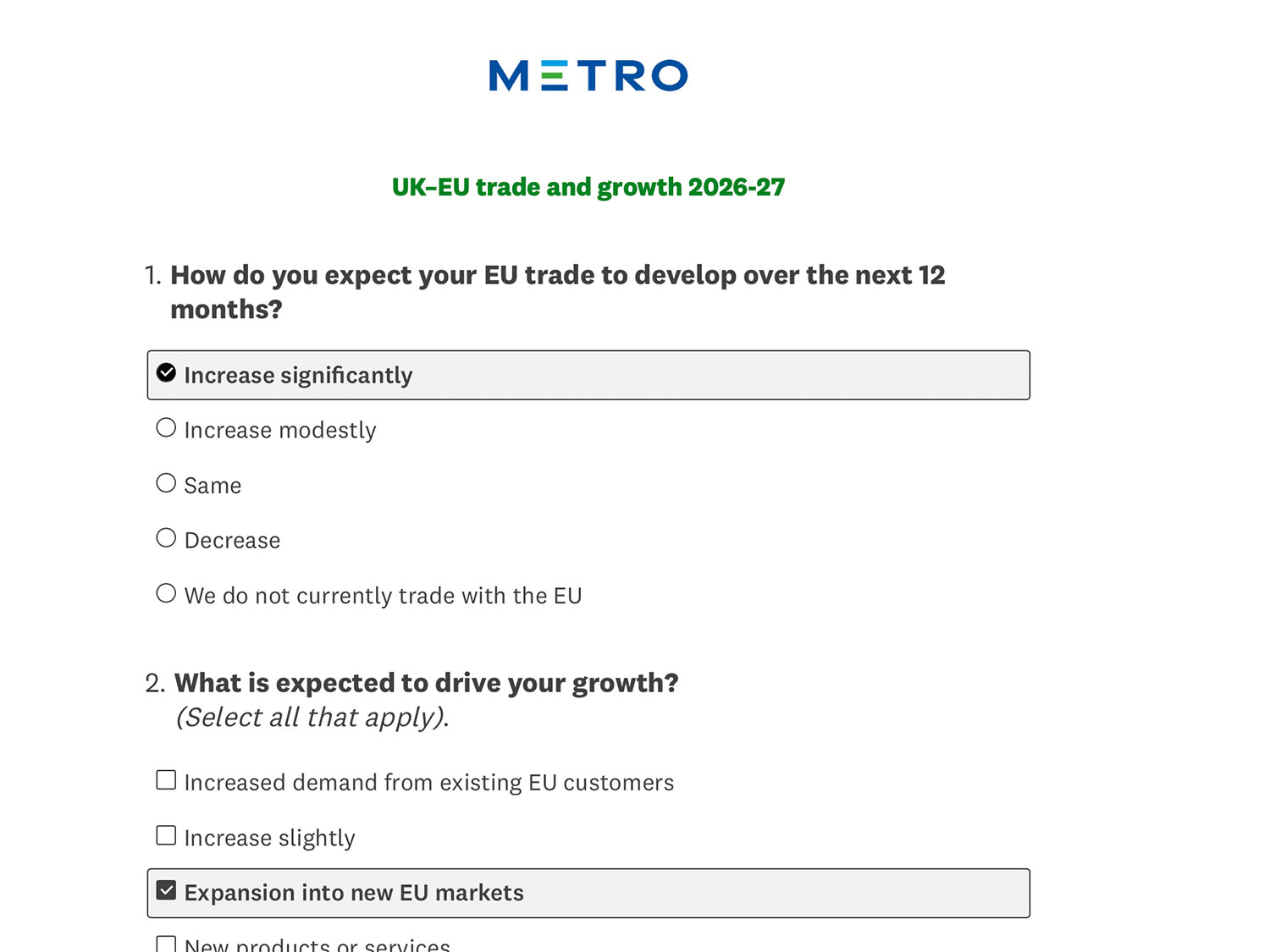
To help us better support your compliance and efficiency goals, including duty/tax reclaims, we encourage you to click the button below to complete our short, five question survey. By responding, you’ll receive tailored insights and support to address any gaps or opportunities within your customs and trade processes.

Carbon Border Adjustment Mechanism (CBAM)
As attention focused on the recent UK government budget, many missed the announcement about the UK’s own carbon border adjustment mechanism (CBAM), coming into effect on 1st January 2027. This CBAM will place a carbon price on high-risk goods imported to the UK from sectors including aluminium, cement, fertiliser, hydrogen, iron, and steel. This measure aims to prevent “carbon leakage” by ensuring the UK’s decarbonisation efforts truly reduce global emissions rather than simply shifting them abroad.

Key points:
• Goods from the glass and ceramics sectors are excluded from CBAM requirements starting in 2027.
• Only businesses importing over £50,000 of CBAM goods annually will need to comply.
• Lessons from the EU’s recent CBAM rollout, which faced data challenges, may offer valuable insights as the UK implements its own system.

Safety & Security Great Britain (SSGB)
The SSGB requires an Entry Summary Declaration (ENS) for all goods imported to Great Britain from the EU, effective from 31st January 2025. Responsibility for filing lies with the carrier or haulier, but as the UK importer, you hold the key data.

Here’s what you need to know:
• For accompanied freight, the origin freight forwarder or haulier is responsible for the ENS submission.
• For unaccompanied freight, the ferry line is responsible.
• Some of the required data can be found on your import customs entry, but certain details may depend on direct or indirect liability, particularly if ENS filing is requested by another party.
• A GB EORI number is essential for those needing access to the system.
• HMRC requires accurate and updated departure details before sailings, although some linking issues with GVMS remain unresolved.

Final guidance is pending, but obtaining EORI information from your suppliers will support this new requirement.

Windsor Framework
The Windsor Framework, replacing the Northern Ireland Protocol, has seen its implementation date pushed from 30th September 2024 to 31st March 2025.

This framework introduces Red and Green lanes for goods traffic and replaces the TSS (Trader Support Service) with the UKIMS (UK Internal Market Scheme). It will simplify trade, particularly for agrifoods moving into Northern Ireland, with the Northern Ireland Retail Movement Scheme (NIRMS) reducing administrative burdens for certain goods.

import control system 2 (ICS2)
As ICS2 progresses for EU surface cargo, European hauliers have voiced concerns about the challenge of gathering essential data. Metro can assist exporters by preparing data in advance from the export entry, keeping hauliers on the move.

Key details:
• Much of the required information is found on the customs entry.
• Emphasis has shifted to 6-digit commodity codes, and the EU consignee’s EORI number is now required.

Simplifying the complex
While the list of complex abbreviations and requirements continues to grow, don’t worry because our team can break down the jargon and provide clear, actionable guidance to ensure smooth customs compliance.

Client survey: Insight into your compliance needs
Please take a few moments to complete our survey. Your responses will help us understand your needs and provide solutions that enhance your compliance and streamline your processes. Thank you for your feedback!

Metro are at the forefront of customs brokerage solutions, with our automated CuDoS declaration platform and dedicated team of customs experts, reacting swiftly to any changes in the UK and EU’s trading regimes.

To learn more about compliance, CBAM, SSGB, The Windsor Framework or ICS2 – OR to see how we can simplify and automate customs declarations – please EMAIL Andy Fitchett, Brokerage Manager.