Suez MSC vessel

Suez and Panama Canal crisis could go either way

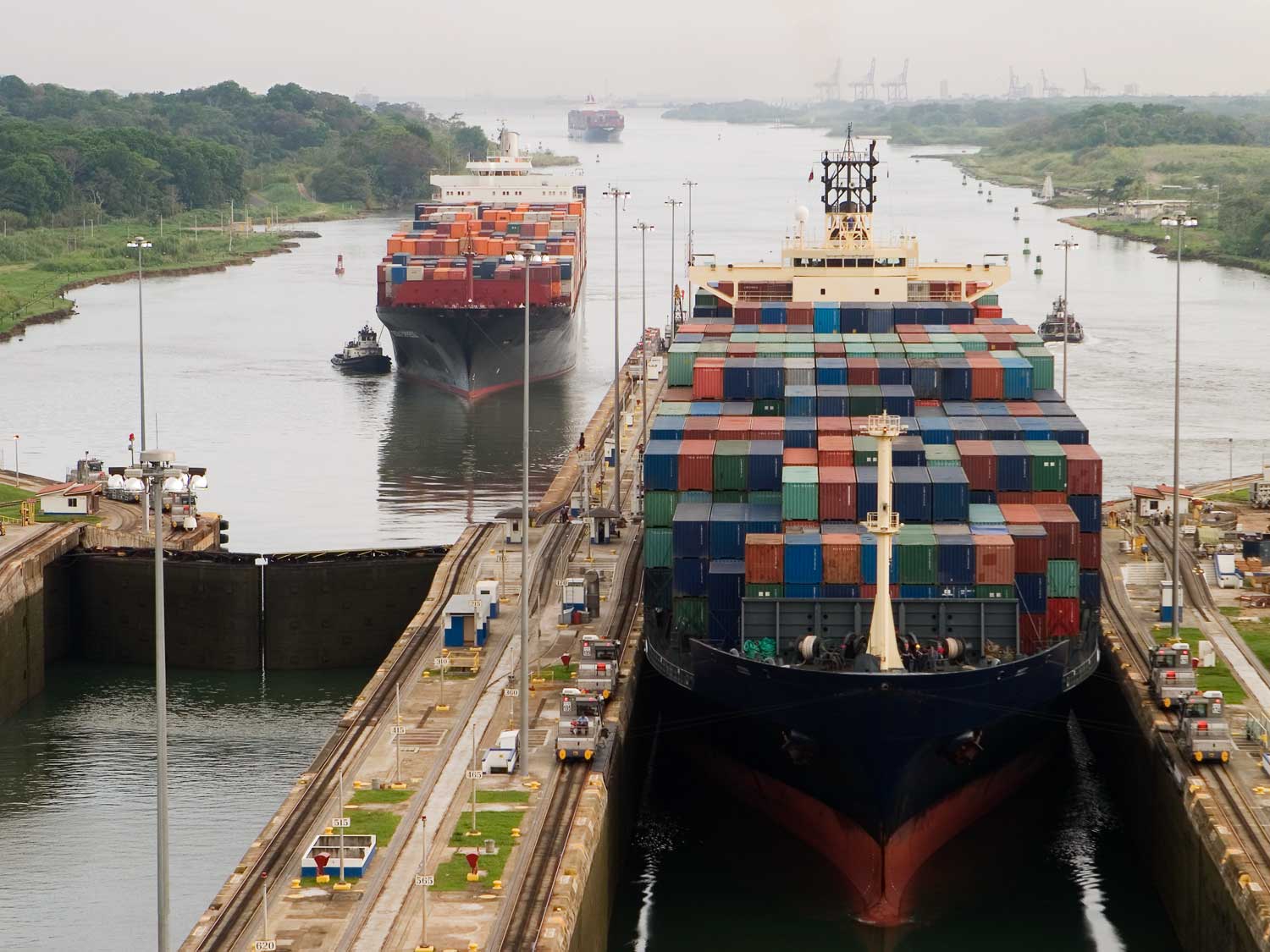
The danger to container shipping approaching the Suez Canal comes at a time when the other key maritime gateway, the Panama Canal has been restricting transit numbers and draught limits due to drought driven low water levels.

Due to the impact of the prolonged Panama Canal drought carriers have had to carry less containers from Asia, to pass through the shallow Panama Canal and accept ‘vessel bunching’ as the reduction in transit crossings creates a queue of ships at either end of the channel.

The issue has been exacerbated by attacks on container ships in the Red Sea, linked to the conflict in the region, with shipping lines suspending sailings through the Red Sea and via the Suez Canal, diverting vessels around the southern tip of Africa, until the security situation improves. 

Shipping via the Cape of Good Hope will add around 3.5k nautical miles, adding approximately two weeks to transit times, with increased fuel consumption potentially leading to significant increases to freight and bunker levels. 

It is likely that carriers will implement emergency surcharges to cover fuel and insurance costs in addition to the loss of revenue from the extended round trip voyage duration.

The extended transit time will soak up available capacity which, when combined with the current blanking programme, could lead to a reduction of up to 20% of global capacity, also leading to growing equipment imbalances.

There are two positives, however…

After better-than-expected November rains, the Panama Canal Authority have announced that they will be increasing the number of ships it accepts each day starting in January, with 24 vessels permitted to pass through, up from 22 currently.

The launch of Operation Prosperity Guardian by the US Navy is forming a coalition that includes the UK, Bahrain, Canada, France, Italy, Netherlands, Norway, Seychelles and Spain, to jointly address the security challenges in the Red Sea and Gulf of Aden.

Suppressing the current threat to maritime trade and creating a system to ensure safe passage of container ships will take time and the shipping lines will need to be certain that all risks have been removed before they will return to the Suez Canal.

If it’s just a month or two, then the Cape of Good Hope diversions may have only a short-term impact on rates, capacity, and equipment availability. But if the security situation cannot be resolved, or worsens, the impact may be profound and long term. 

The longer it takes to resume the normal Suez Canal routing, the greater the likelihood of a knock-on effect into the airfreight market, as vessel delays push shippers to move urgent cargo via air, therefore increasing demand and pushing up rates.

These are both evolving situations, which are liable to change at any time, which is why we share important updates.

We are proactively advising customers with updates on individual vessels and routes, while our AI-powered ocean visibility tools predict ETAs based on the current situation, vessel location and liner information. 

Please be assured that we will continue to communicate proactively during this developing situation and will provide customers with updated ETA’s accordingly.

wing merro dusk

Supply chain; a year in review

2023 was supposed to be the year that global supply chains bounced back from pandemic lockdowns and factory shutdowns, trade wars, tariffs and war in Europe, but now container shipping is disrupted by attacks in the Red Sea and restrictions on the Panama Canal.

The COVID pandemic and its aftermath, with supply-side fluctuations, shipping delays and port congestion created a logistics storm so brutal that many wondered if supply chains would ever recover.

The dramatic increase in consumer spending during the pandemic that left shippers scrambling for air, road and sea space, quickly fell away at the beginning of the year as consumers faced potential recession and a cost of living crisis.

That fall in demand provided the breathing space for carriers and ports to resolve their capacity and performance issues, clear backlogs and reposition equipment effectively, with markets reverting to pre-pandemic levels in terms of capacity and pricing.

The uncertainties surrounding tariffs, trade wars and geopolitical tensions remain, but there has been no significant move away from China, though we are seeing some diversification of sourcing, with Vietnam and Bangladesh - among other origins - increasingly popular.

While container shipping demand fell away the global shortage of RoRo capacity for finished vehicle shipments led to some car manufacturers to acquire their own vessel assets, while others looked to our containerised shipping solutions, for cheaper sea freight movement and certainty of service.

On the air freight front, having joined the Air France, KLM, Martinair Cargo Sustainable Aviation Fuel (SAF) programme in 2022, we were extremely pleased to support their second sustainable flight challenge in the summer, which was followed a few months later by the first transatlantic SAF-powered crossing, accelerating the transition to a more sustainable airline industry.

Metro’s road freight division has grown significantly in 2023, with more team members joining our UK Birmingham HQ and new support operations located close by manufacturing hubs in Desford and Wythenshawe.

Under new leadership the road freight team have increased European FTL/LTL capability, adding more lanes and expanded our groupage offering, alongside the increasingly popular European Distribution (EU/DDP) solutions. 

As the UK deferred post-Brexit food checks for the 5th time, to avoid adding to food inflation, the EU expanded its Emissions Trading System to the container shipping sector, in a move that will cost carriers, and by extension shippers, $Billions from the start of 2024.

In a move that took the market by surprise (but shouldn’t have) the European Commission announced that it would not renew the container shipping sector’s Consortia Block Exemption to operating alliances in 2024.

Despite the initial panic, it is likely that the EC’s decision will have little real impact, particularly as the Maersk and MSC 2M alliance was already ending, with the others likely to reorganise into new structures.

With 2024 just weeks away, scheduled Trans-Pacific and Asia to North Europe container shipping capacity was up 30% and 10%, raising fears of a massive blank sailing program to try and support rates, but now, with the Suez Canal transit suspended and Panama Canal disruption, we may see increased rates and delays, with air freight’s popularity rising.

We are hopeful that the US and coalition navies can restore maritime security quickly, because the prolonged re-routing of vessels away from the Suez Canal, via the Cape of Good Hope will increase transit times and costs, with a massive reduction in available capacity and a return to equipment imbalances.

Whatever challenges 2024 may bring, you can rest assured that we will keep you informed and protected, because we always have your back covered.

Suez map

Container shipping lines to avoid Suez Canal

Following further attacks on merchant shipping, entirely unconnected to the conflict between Israel and Hamas, container shipping lines have suspended sailings through the Gulf of Aden and Red Sea with immediate effect.

MSC announced on Friday, after the MSC Palatium III was attacked and suffered fire damage, that its vessels would not transit the Suez Canal eastbound and westbound "until the Red Sea passage is safe".

Maersk and CMA CGM have stated that all ships in the Red Sea area will pause their journey until further notice, with Hapag-Lloyd also pausing container ship traffic and due to make a decision on routing today.

The Suez Canal is a critical artery for global supply chains, and as seen when the Ever Given ran aground two years ago, blockages cause schedule disruption for container shipping and delivery delays.

ONE vessels are in holding patterns and HMM vessels were seen on Friday being diverted around Africa, while COSCO vessel, the COSCO Galaxy appeared to have stopped into a holding pattern in the Red Sea yesterday, despite the Chinese carrier not yet issuing any statements as to their position on the threat.

With over 30% of global containerised traffic moving through the Suez Canal, the decision to avoid it will have a profound impact on supply chains from Asia, with vessels sailing a further 4500 nautical miles around Cape of Good Hope, burning a lot more fuel and adding around 10 days to their transit.

If all services that would usually go via Suez now re-route via the Cape it would add 3-4 weeks to transit times on total round trip voyages, effectively remove approx 25% of capacity and would also mean that equipment shortages will become a major issue again.

Re-routing via the Panama Canal is not an option currently, particularly for larger vessels, due to the ongoing drought situation. 

However, this may change in time as solid amounts of rain over the past six weeks mean that the Panama Canal Authority (ACP) will increase daily transits to 24. 

This is an increase on the forecasted daily transits of 20 slots for January and 18 slots for February, but is still insufficient to be a solution for the Suez situation.

It’s too early to determine the impact this will have on international shipping, but it is worth noting that freight costs and insurance premiums are almost certain to rise, as shipping lines pass on the additional costs of the extended voyages.

We have very limited intel from the shipping lines currently, but as we learn how individual vessels and routes are affected we will advise customers accordingly. 

Please be assured that we will continue to communicate proactively during this developing situation and provide will customers with updated ETA’s accordingly.

KLM Boeing 787 10 Dreamliner

Supporting sustainable fuel for air and sea freight

As we move into our second year of Sustainable Aviation Fuel (SAF) investment, with Air France, KLM, Martinair, it is great to see the successful transatlantic flight, greater SAF availability and increasing options for green sea freight transport.

The first transatlantic flight by a large passenger plane powered only by SAF landed in the US last week, demonstrating our belief that a greener way of flying freight is possible and that SAF as the most effective tool to help bring net emissions down to zero.

The doubling of SAF biofuel production in 2023 was encouraging as is the expected tripling of production expected in 2024.

However, demand for SAF is not the issue, because every drop produced has been bought and used, it is unlocking supply to meet demand that is the challenge which needs to be solved.

As a portion of renewable fuel production SAF will reach 6% in 2024 and aviation needs between 25% and 30% of renewable fuel production capacity for SAF, so we are on the trajectory needed to reach net zero carbon emissions by 2050. 

There have also been big green steps in container shipping, with carriers investing in energy efficiency for new vessels, while retrofitting their existing fleet for efficiency. 

Shipping lines have been embracing biofuel in the form of methane, methanol or fuel oils, because they promise a convenient way to reduce carbon emissions due to their ability to be mixed with similar versions of fossil fuels and used to power existing engines. 

This is an extremely attractive decarbonisation solution for shipowners as it reduces the need for investment for other decarbonisation options, such as the retrofitting dual-fuel capability. 

As with air, one of the biggest issues facing biofuels in sea freight is supply, with about 5,000 biofuel production facilities worldwide currently, with production of advanced biofuels at 11 Mtoe in 2023 and expected to rise to 23 Mtoe per annum by 2026. 

Whilst this represents strong growth, it still falls short of the volume of biofuels that shipping would need in order to make a big impact on decarbonisation efforts, though many in the industry feel shipping should be prioritised for biofuel supply over other sectors.  

A win for shippers 

Despite the challenge facing biofuel rollout to the shipping sector, there are biofuel solutions available for shippers committed to reducing their emissions.

Shipping lines will bunker biofuel upon the request of customers, allowing them to achieve their emission reduction targets, by paying the difference in fuel cost.

While biofuel is not currently available at all ports, it is possible to offer CO2 savings to customers along any trade lane and route as biofuel is bunkered and used across shipping alliances networks.

In reality shipping biofuel solutions will currently only be practical for the very largest shippers, with Nestlé announcing an agreement today with Maersk and CMA CGM to move 100% of their cargo with biofuel, which will reduces CO2 emissions by 80%

Metro has been carbon-neutral for several years and is committed to extending this zero-emission strategy as far down customers’ supply chains as possible, which is why we welcome the shipping lines efforts and are the first forwarder to invest in the Air France KLM Martinair Cargo SAF programme.

Metro is measuring and monitoring the emissions of every shipment, by every mode, for all of our customers, with offsetting alternatives, so they can work towards carbon neutrality in their global supply chain. 

Our MVT ECO module has reported over 100,000 shipments, with a total CO2 equivalent of more than 300,000 tonnes in 2023.

The MVT ECO module is available free-of-charge to customers on their MVT dashboard. To request a demo or discuss your requirements, please EMAIL Ian Powell.