Blanking is biting

Blanked Sailings Amid Geopolitical Shifts

Global sea freight is navigating a complex landscape marked by geopolitical tensions, fluctuating demand, and strategic capacity adjustments and while a temporary US-China tariff truce offers a glimmer of hope, challenges persist across major trade lanes.

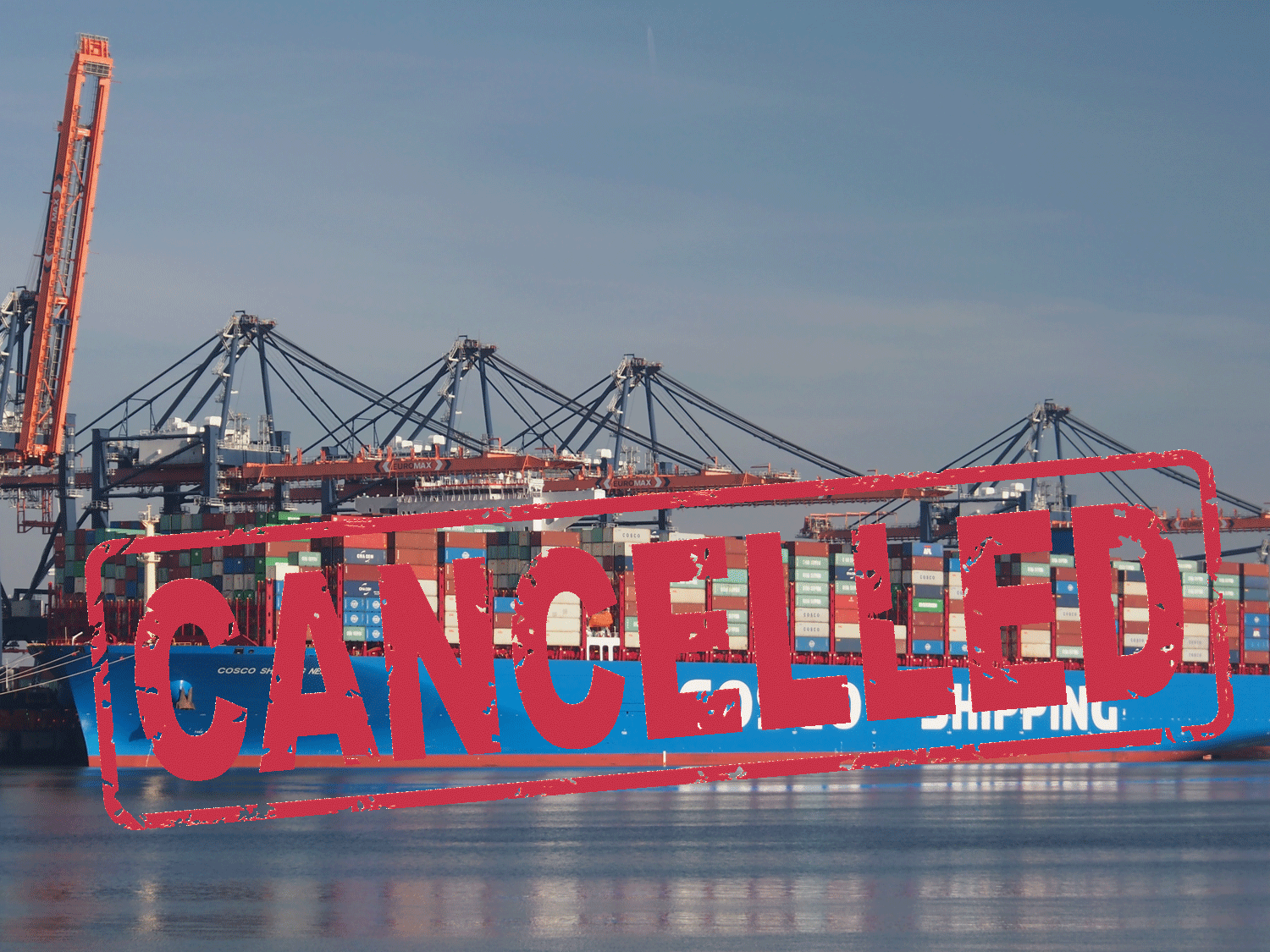
In response to weakening demand, particularly on transpacific routes, ocean carriers have taken aggressive steps to manage overcapacity. Year-on-year capacity reductions of around 4% to 5% have been recorded on Asia-North America trades for April and May. The Asia to US East Coast route has been especially impacted, with reports suggesting shippers face as much as a 40% cut in weekly slot availability due to a sharp rise in blanked sailings. Some weeks have seen up to 10 scheduled services withdrawn.

The trend of blank sailings is not uniform across all alliances. Major players have taken divergent approaches, with some choosing to maintain network stability while others have opted for deep cuts to protect rate levels. MSC, the world’s largest shipping line, has launched a sweeping revamp of its east-west network, consolidating services and shifting vessels between routes in an effort to optimise capacity and mitigate the financial impacts of underutilised sailings.

The effect of these service cancellations has been most visible in spot rate volatility. Container spot rates between Asia and Europe have been pressured as additional capacity and lower-than-expected booking levels weigh on prices. In contrast, rates from Asia to the US, particularly the US West Coast, have remained relatively firm due to tighter supply caused by blank sailings and ongoing retailer inventory replenishments.

The scale of blanked sailings is contributing to a growing sense of uncertainty in booking reliability. With last-minute sailing cancellations and frequent schedule changes becoming increasingly common, an emerging trend has been to split bookings across multiple carriers to hedge against cancellations.

US-China Tariff Truce: A Temporary Respite
Amid this volatile environment, the recent US-China agreement to temporarily reduce tariffs for 90 days from May 14 offers some hope. The US has lowered tariffs on Chinese goods from 145% to 30%, while China has eased tariffs on US imports from 125% to 10%.

The impact of the tariff pause has yet to fully filter through to shipping demand. However, many in the industry hope it could reignite volumes, especially in the transpacific trade, which has been hardest hit by tariff-driven disruptions and reduced consumer demand. The long-term benefits depend on whether this truce leads to a broader and more lasting trade agreement.

Looking Ahead: A Market in Flux
Even with the tariff reprieve, the global sea freight market faces lingering challenges. The combination of excessive vessel deliveries into a market of uncertain demand is expected to maintain downward pressure on rates in the months ahead. Ocean carriers are likely to continue balancing network adjustments, including further blank sailings and service restructures, to keep load factors at sustainable levels.

Some industry observers note that capacity cascading is already underway, with surplus vessels being redeployed to secondary trades such as Asia-Europe or intra-Asia, although these markets cannot fully absorb the overflow from the transpacific.

The situation remains fluid, with geopolitical risks, shifting consumer spending patterns, and global economic uncertainty all contributing to ongoing volatility. While the short-term outlook is mixed, we remain focused on managing risk and seeking stability in what continues to be a highly dynamic and unpredictable market.

The global sea freight market continues to adjust to shifting demand and capacity changes. With significant change underway, now is the ideal time to review your ocean freight strategy to ensure continuity and flexibility. EMAIL Andy Smith, Managing Director, to discuss how we can support your business with tailored solutions that keep your supply chain resilient and competitive.


businessman stressed

The Rising Risks of Customs Valuation and Tariff Compliance

For importers under pressure to manage margins amid rising tariffs, compliance missteps, even unintentional ones, can trigger severe penalties, criminal sanctions, and lasting reputational damage.

Recent high-profile cases show that even the most established brands are not immune. At one major logistics hub in Europe, authorities are investigating a leading sportswear manufacturer over its import valuation practices.

The issue centres around how the company structured transactions before goods entered the EU — allegedly calculating customs duties based on an earlier, lower sale price rather than the final transaction value, potentially underpaying significant duties and VAT. With potential liabilities reported at €1.5 billion, the case is a stark reminder that customs valuation errors can escalate into major legal and financial risks.

It’s important to recognise that the rules have evolved. While using an earlier sale value was once a common and accepted practice, EU authorities revised their stance in 2016, shifting firmly towards the “last sale” principle for determining customs value. Businesses that have not adjusted their processes accordingly are now exposed to greater scrutiny — and enforcement action.

The drive for stricter enforcement is not limited to valuation practices. Across the board, customs authorities now treat tariff evasion including undervaluation, transshipment, and misclassification with the same seriousness as tax fraud.

Consider a company importing consumer electronics from a high-tariff country. To reduce duties, it may consider declaring the goods under a low-tariff category such as “educational devices,” or submit an invoice showing less than the true value. While such schemes might be tempting and yield cost savings, they expose companies to major legal and financial liabilities.

Enforcement is ramping up globally
In March 2025, a federal court sentenced a Florida couple to nearly five years in prison for defrauding US Customs of over $42 million by routing plywood through Malaysia and falsifying documents.

In the same month, a San Francisco-based flooring company agreed to pay $8.1 million to settle allegations that it disguised Chinese flooring as Malaysian to evade antidumping and Section 301 duties.

In February 2025, a UK firm paid over £3.2 million to HMRC after exporting military goods without the necessary licences.

In December 2024, prosecutors raided another leading sports brand’s European headquarters, investigating alleged customs and VAT evasion worth over €1.1 billion.

What Importers Need to Watch
Following the April 2025 introduction of the US’s new tariff regime — with a 10% baseline tariff and stackable surcharges for many countries — authorities have intensified scrutiny of:

  • Country-of-origin declarations
  • Shipment valuations
  • Tariff classifications

In the US, the False Claims Act allows for treble damages and substantial penalties where duties are knowingly underpaid.

In the EU, the Directive on Administrative Cooperation (DAC6) imposes disclosure obligations on cross-border arrangements that obscure transaction value or jurisdiction meaning that rerouting goods or mis-declaring valuations can trigger automatic reporting requirements.

Meanwhile, in the UK, the Criminal Finances Act introduces strict liability for companies that fail to prevent the facilitation of domestic or foreign tax evasion. Businesses must be able to demonstrate “reasonable procedures” to avoid criminal exposure.

How Metro Supports You
At Metro, our customs and compliance experts provide critical support to businesses navigating today’s complex trade landscape.

We help importers to:

  • Verify country-of-origin declarations and supply chain transparency
  • Ensure correct valuation methodologies are applied
  • Review tariff classifications and supporting documentation
  • Establish strong compliance frameworks, audit trails, and proactive reporting systems

Our goal is simple: to help you reduce risk, protect your reputation, and trade with complete confidence across any border.

In today’s environment, customs compliance isn’t just a technical obligation — it’s a strategic imperative.

To review your situation and learn how we can keep you compliant, while protecting your cashflow – please EMAIL Andy Fitchett, Brokerage Manager.

eCommerce2 1440x1080 1

UK De Minimis Rule Under Review

The UK government has announced plans to review the longstanding de minimis tax exemption for low-value imports, in a move that has been welcomed by major British retailers.

The rule currently allows goods valued at £135 or less to enter the UK without incurring customs duties; a system critics argue has been exploited by international eCommerce platforms at the expense of UK businesses.

The Latin term “de minimis” translates to “the smallest things” and has traditionally been used to justify the exemption of very low-value goods from burdensome customs procedures. However, as eCommerce volumes have grown and global online platforms increasingly rely on this exemption, its relevance and fairness have come under scrutiny.

Speaking at the IMF Spring Meetings in Washington DC, Chancellor Rachel Reeves signalled the government’s intention to help UK firms compete fairly by closing the loophole that international sellers have used to undercut domestic retailers.

Retailers argue that platforms like Temu and Shein leverage the exemption to ship millions of low-value parcels into the UK each day, often without meeting British environmental, ethical, or consumer safety standards, and are sold duty-free while UK retailers pay full VAT and import taxes.

Helen Dickinson, Chief Executive of the British Retail Consortium, said the review is “most welcome,” emphasising that it could prevent the UK from becoming a dumping ground for substandard goods in the wake of global trade turmoil.

Jonathan Reynolds, the UK’s Business and Trade Secretary, echoed this sentiment, promising “urgent steps to deliver quicker protections” for domestic firms.

The issue mirrors changes in the US, where the government has already lowered its de minimis threshold from $2,500 to $800 and is preparing to end the exemption altogether for China from May 2.

Retailers argue that eliminating the de minimis loophole would not only create a level playing field, but also enhance consumer protection, increase tax revenues, and support the struggling High Street. As the UK prepares to engage with stakeholders in the coming months, the move could reshape how global eCommerce platforms operate within the British market.

As tax exemptions tighten, Metro’s end-to-end airfreight and courier solutions combine speed, cost-efficiency and full regulatory alignment for both parcel and bulk eCommerce shipments.

With strategic block space agreements (BSA) and capacity purchase agreements (CPA) in place, we secure priority capacity and competitive rates across high-demand trade lanes so your products keep moving, even as the rules shift.

EMAIL Elliot Carlile, Operations Director, today to explore how Metro can help you stay compliant and competitive.

BKR 1440x1080 1

Unlock Savings and Strengthen Compliance with BKR Consultants

We’re always looking for ways to support our clients and that includes helping you stay on the right side of HMRC, while making the most of your duty spend. That’s why we’re proud to introduce BKR Consultants, a trusted member of our group and a specialist in customs compliance.

Based across the UK, BKR Consultants bring deep expertise in customs brokerage, health and regulatory affairs and international trade. Their team provides independent, professional advice that helps importers and exporters stay compliant – and uncover meaningful opportunities to save and reclaim money.

Even businesses with experienced in-house customs teams can find it challenging to keep up with evolving legislation or spot every error. That’s where BKR’s customs compliance auditing service adds real value.

Why Consider an Independent Customs Audit?
Even with a strong internal customs team, it’s easy for issues to slip through the cracks. Classification errors, unsupported preferential claims, and small inaccuracies can quietly add up to major costs, or worse, attract an HMRC audit.

That’s where BKR Consultants come in.

Their independent audits offer a second set of expert eyes on your customs activity, using your actual data to uncover risks, identify opportunities, and ensure your business is fully aligned with HMRC expectations. And this isn’t just theory: BKR have already recovered millions of pounds for clients through the identification of overpayments and incorrect classifications.

From reassessing the way your goods are declared, to helping you access duty-saving procedures, BKR’s audits are practical, actionable, and focused on results.

What’s more, BKR make a simple promise: to leave every client – no matter how big or small – in a better place.

That might mean improved internal knowledge and confidence, a measurable financial refund, or a more stable and compliant business overall.

Here’s what you can expect:

  • A detailed review of your customs declarations and documentation
  • Identification of compliance issues and corrective action plan
  • Retrospective duty reclaims and long-term cost reductions
  • Access to BKR’s trade analytics platform to explore trends and track progress

By engaging BKR, you can:

  • Eliminate risks before they become costly problems
  • Improve cash flow by reclaiming overpaid duties
  • Reduce administrative burden by outsourcing time-consuming checks
  • Strengthen your compliance posture ahead of any HMRC audits

Take the First Step — Book a Free Consultation
Whether you’re already questioning the accuracy of your declarations and duty payments, or simply want the reassurance of a compliance check, BKR’s audits are designed to leave your business in a stronger position – financially, operationally, and strategically.
EMAIL Lucy Hulston to Book your Free Consultation.