Francis Scott Key Bridge 1 1440x810 1

Maersk vessel collapses Baltimore bridge

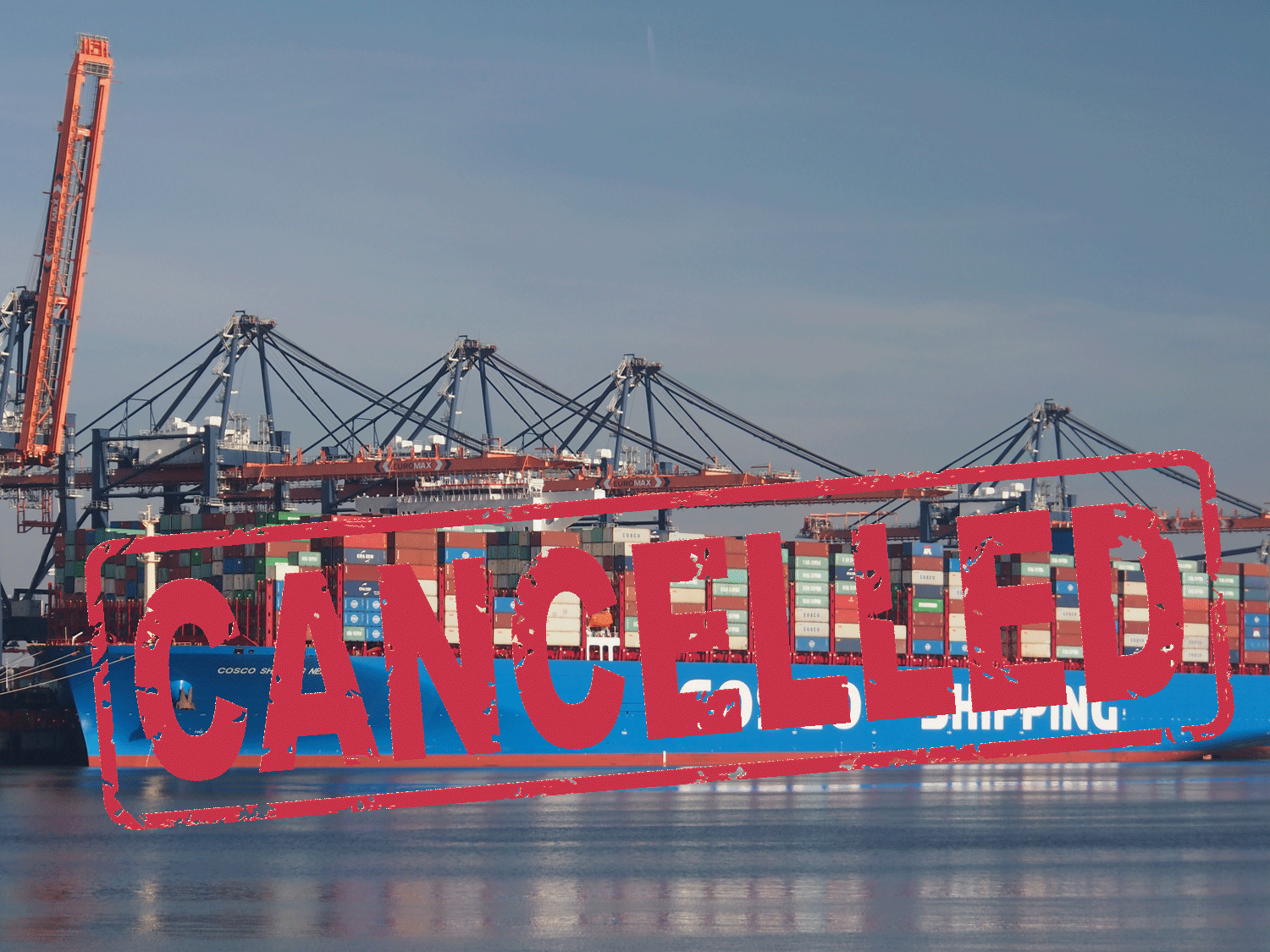
The Dali, a time chartered Maersk container vessel with two pilots onboard, crashed into a support pylon of the Francis Scott Key Bridge in Baltimore, Maryland, in the early hours of Tuesday 26th February, collapsing a large section of the 1.6 mile bridge into the Patapsco River.

The Francis Scott Key bridge was the main thoroughfare for drivers between New York and Washington who sought to avoid downtown Baltimore. It was one of three ways to cross the Baltimore Harbour, with a traffic volume of 31,000 cars per day or 11.3 million vehicles a year.

The collapse of the bridge has cut off access in and out of the port for vessels. Around the world, about 40 ships, including 34 cargo vessels, have Baltimore listed as a destination, including 10 commercial ships with anchors dropped in nearby waters, according to MarineTraffic.

Baltimore port’s private and public terminals handled 847,158 autos and light trucks in 2023, the most of any U.S. port.

On top of the RORO operations Baltimore port handles around 21,000 TEU a week, which will have to be re-routed via other ports in the region until access is restored.

It is still unknown how long the port will be cut off due to the incident, but any length of downtime will greatly impact RORO capacity into the US East Coast, as well as cause additional congestion at alternative ports that will need to take on the overflow of ocean containers that would naturally route through Baltimore.

This also comes at a time when there is an element of uncertainty regarding the future situation at the US East and Gulf Coast ports due to the International Longshoremen’s Association and the United States Maritime Alliance current contract set to expire on 31st September 2024. Whether this incident will have any impact on the negotiations remains to be seen but Metro will be monitoring the situation closely and will be keeping our customers informed.

Automotive logistics contingency

The impact on RoRo, container and conventional freight moving into Baltimore is going to be significant. Baltimore is one of the largest RoRo ports for global vehicle movements into and out of the US East Coast. Carriers have already began to advise of diversions and avoidance of the port for the foreseeable future across all ocean freight modes.

We anticipate that there will be a consequential effect on vessel rotations and schedules ongoing to and from Europe and that vehicle compounds at alternative ports will become congested adding further to the impact, especially on the automotive sector.

RoRo carriers are already seeing a surge in bookings, adding further pressure on the high demand routes to the US. We will continue to update on the situation and market intelligence as it unravels. The impact will be ongoing for many weeks, and as experienced from the pandemic and Red Sea situations it is likely that indirect issues will arise as an outcome of the initial tragedy.

Metro have alternative solutions to Baltimore gateway and we can provide containerised services for vehicles and also other gateways into the US.

We are currently compiling the alternative options that we have and can share these with you in conjunction with our partner shipping lines and local offices in the US.

Please contact us for further information and speak with your account manager who will be delighted to arrange a meeting or Teams call to discuss the options available and your own specific needs and forecasts during the period of closure.

If you would like any further information on this solution and how it can work for you please do not hesitate to EMAIL our Automotive Account Director, Ian Tubbs.

SEE ALSO THIS BBC ARTICLE: Fears of disruption to global supply chains after Baltimore bridge crash

New York port 1440x1080 1

TPM and US review

Organised by the Journal of Commerce, TPM (Transpacific Maritime Conference) is the premier global shipping and supply chain conference, attracting senior executives from all areas of the industry.

Held annually in the port city of Long Beach, California, TPM brings together shippers, carriers, freight forwarders, intermodal operators and technology providers to discuss the most pressing global challenges and developments, for a week of essential networking, seminars, and relationship building.

With over one hundred presentations, interactive speaker sessions and networking events, and almost two hundred speakers, including leaders from the largest brands and carriers on the planet, TPM really is in a league of its own.

Metro’s Chief Commercial Officer, Andrew Smith, joined this year’s conference, to participate in TPM’s insightful panels and forward-thinking discussions to explore the global dynamics and challenges impacting ocean supply chains.

Andrew said “It was important to take the opportunity to travel out to Long Beach for TPM as part of my recent visit to the United States, to meet key customers, partners and carriers. It was a full on trip, encompassing seven cities across the country in just over a week, and the time spent talking to customers in particular was invaluable”.

“The Red Sea crisis was obviously a major talking point among delegates and in particular how to manage a situation which appears to have no immediate solution and is likely to continue for the foreseeable future.”

“TPM was as interesting and insightful as always and I think the key takeaways are well-worth sharing.”

“Keynote speaker Robert Gates, the former CIA director, painted a picture of a world where increasing local conflicts should be anticipated and with the global geopolitical landscape the most challenging it has been for decades, preparedness for future supply chain disruption is essential.”

“In this environment it is perhaps natural that so many shippers are looking at de-risking their supply chains. Resilience and flexibility are at the core of de-risking, with initiatives such as multi-carrier programmes, sourcing diversification, re-shoring and near-shoring.”

“Another takeaway worth highlighting is that despite all the current operational challenges, sustainability still remains top of the agenda for carriers and major shippers, and the TPM programmes reflected this, with nearly a third of the scheduled events featuring environmental, transformation and sustainability issues.”

“My visit to the United States, alongside Metro colleagues regular trips, reiterate our focus and commitment to this important market. This focus will continue and ramp-up further with a new route development role created to expand both customer and partner engagement.”

“To discover how we can support your Transpacific or Transatlantic trade needs, or to discuss any of the issues highlighted here, please reach out to me directly via EMAIL.”

metro tech

2024 tech road-map

Metro has been innovating leading-edge supply chain management, tracking and business-process technology for 20 years and in 2024 we will continue to increase our ability to integrate with stakeholders, share real-time data, accelerate workflows, automate processes and optimise our customers’ supply chains.

In 2024 we continue to focus on the core pillars of our technology strategy:

  • DigitalisationThe continued adoption of digital technologies that improve processes and create new opportunities
  • Digital twin: Creating indistinguishable digital counterparts to the physical supply chain
  • Platform Engineering: Accelerated development in customer facing applications
  • Big data: Integrate, manage, and analyse to uncover and deliver business value

The last quarter planning of 2023, including our cross-functional workshops, provided the springboard and momentum to start delivering against our product roadmap objectives, with the team achieving early successes in 2024 including:

January

  • Deployed comprehensive updates to our vessel tracking capability in MVT Track & Trace to provide customers with enhanced visibility, deviation reporting and insights resulting from the Red Sea crisis disruption
  • Development, launch and deployment of bespoke applications to provide enhanced control, visibility and regulatory compliance in specific parts of the supply chain for FMCG, Retail and Industrial & Manufacturing customers

February

  • Successfully completed the final cut-over from our legacy TMS to CargoWise CW1 product and initiated a continuous improvement programme to identify where we can drive further optimisation of business processes, with a blend of technology and automation
  • Successfully completed multiple system integrations to both customer facing (x6) and 3rd party (x1) systems
  • Initiated our ISO27001 information security accreditation, to demonstrate our commitment to compliance and cyber security practices in building customer confidence of our technology offering

March

  • Launched enhancements to our CW1 TMS and CUDOS customs platform application which further improves our customs clearance times and service delivery to customer
  • Further development to the Metro rebranding and new website, that showcases our services and commitment to deliver for our customers

These early successes spur us on to continue the delivery of our ambitious 2024-2025 plans.

We are excited to announce that we will be expanding the technical solutions team and, as part of our global strategy, we will leverage our wholly owned office in Chennai, India to base local developer talent to accelerate the pace of delivery.

We are confident that complementing our existing team with a cohort of colleagues in India will bring valuable insights, expertise, and creativity to our projects and help us achieve our vision.

If you know any high performing developers in India who are looking to join a dynamic, forward thinking and technology focused freight forwarder, please encourage them to submit their CV, via our careers page.

We are excited for what 2024 will bring and how our technology roadmap will aid the delivery of Metro’s strategic objectives.

Metro is leading the industry in developing the technologies and platforms that simplify and enhance optimal supply chain management.

Visibility, control, environmental, and customs modules, blend together with integrations of critical digital trade documents, including electronic bills of lading (eBL) to provide an unparalleled supply chain platform.

EMAIL Ian Powell for further Information on our digital capabilities and how we can support your global trade and business growth ambitions.

Panama Canal

Sustainability key to long-term Panama Canal

With 5% of global maritime trade and 40% of US container traffic using the Atlantic-Pacific shortcut, the Panama Canal is a critical link in global supply chains and the drought-driven disruption which started last year is finally relenting, with the key waterway expected to be operating at full capacity by September.

In the first 10 weeks of the year, nearly five million TEU left the Far East for the USA, an increase of 16% compared to 2023, with lines increasing capacity by 24% to meet demand and with capacity for the East Coast up 15% the Canal’s operational capacity is critical.

The Panama Canal transports ships 26 metres above sea level across the mountains and unlike the Suez Canal is reliant on fresh water, but lack of rain and the El Nino weather phenomenon have contributed to the second driest year in the canal’s 110-year history.

Since last summer the Panama Canal Authority (ACP) has had to introduce water-saving measures, which has meant fewer ships can pass through the canal each day, eventually cutting transits by over a third.

Deputy Administrator Ilya Espino de Marotta was appointed as the Panama Canal’s first Chief Sustainability Officer in January, emphasising their ongoing commitment to sustainability.

Ms De Marotta has said that the rainy season starts in late April to early May and they are hoping to increase transits to 34 by the end of May, returning to the normal 38 transits by September.

The ACP is looking to ensure that the restrictions in place since last summer and the subsequent delays will not be repeated, with projects currently underway to ensure reservoir levels are stabilised for the coming year, including the reuse of water from one lock chamber to another, which is saving the equivalent of six daily crossings.

The authority is also considering building reservoirs, its first major project since it completed the new set of locks in 2016.

Another option is to build desalination plants, but it is costly and requires a huge amount of energy. Even seeding clouds to create more rain isn’t off the table and in the medium term ACP is proposing an additional lake, so water levels can be maintained and add between 11 and 15 passings each day, elevating daily transits to around 50.

The project is reliant on government approval and the existing Panamanian government is not supportive, but in May Panama is holding a general election and the ACP is optimistic that the new administration will ratify the project.

If you have any concerns relating to the Panama Canal or your transpacific trade, we can review your situation and outline your options, including road and rail transhipment, and alternative carriers, ports and routes.

Whatever your challenges, our long-term ocean carrier relationships deliver cost-effective, resilient and reliable ocean solutions. EMAIL Andrew Smith, Chief Commercial Officer to learn more.