LAX 1440x1080 1

Air Freight Market Review

The global air freight market in February and early March reflected moderate year-on-year (YoY) growth, with total worldwide tonnages up 5% in February and 2% higher YoY in early March.

However, market dynamics remain volatile, influenced by shifting trade policies, geopolitical factors, and eCommerce trends.

Asia-Europe air cargo showed strong demand recovery in March, with tonnages rising 4% week-on-week (WoW) and while average spot rates softened they remain 20% higher YoY. Meanwhile, transatlantic routes saw weaker demand from Europe, with London Heathrow and Frankfurt spot rates declining amid softer outbound trade.

Market Situation
Global air cargo tonnages rose 5% YoY in February, supported by an 8% surge from Asia Pacific and a 4% rise in North America and Europe. However, Middle East & South Asia (MESA) volumes declined by 6%, reflecting last year’s Red Sea-driven demand spike.

By early March (Week 10), Asia-Europe trade saw significant WoW volume gains:

  • China to Europe tonnages increased by 5%
  • Hong Kong to Europe volumes grew by 6%
  • Japan & Taiwan to Europe rose by 7%
  • Thailand & Singapore to Europe surged by 9%

Despite these volume increases, average spot price indices on Asia-Europe lanes declined by 3%. However, YoY spot rates remain significantly higher (+20%), supported by China (+14%), Hong Kong (+22%), Japan (+19%), and Thailand (+38%).

Global air cargo markets remained relatively stable through February and early March, with weekly demand fluctuations balancing out across key regions.

  • Asia-Europe: Despite a 4% WoW tonnage rebound in Week 10, rates dipped as supply-demand balances shifted.
  • Transatlantic (Europe to USA): Weaker outbound demand put spot rates under pressure at London Heathrow and Frankfurt.
  • Middle East to Europe: Demand weakened with Dubai-to-Europe tonnages falling 15% WoW.

Global air freight rates remained 6% higher YoY, though Asia-Europe pricing showed a mixed trend, with falls on all the major trade lanes, though rates remain significantly higher than last year.

  • Asia-Europe remains 20% higher YoY.
  • China to Europe still stands 14% higher YoY.
  • Hong Kong to Europe are up 22% YoY.

The Asia-Europe air cargo market rebounded in early March, with tonnage gains but slightly softer rates as market conditions adjusted. Meanwhile, transatlantic routes saw demand weakness, leading to rate declines from major European hubs. Moving forward, trade policies, geopolitical shifts, and capacity adjustments will continue to influence global air cargo pricing and volumes.

In a volatile air cargo market, securing capacity and competitive rates is critical. Metro’s air freight, charter, and sea/air solutions ensure your shipments move efficiently, even on the busiest trade lanes. With block space agreements (BSA) and capacity purchase agreements (CPA) in place, we guarantee space and stable pricing when you need it most.

Whether you’re shipping urgent, high-value, or sensitive cargo, our global expertise and strategic carrier partnerships keep your supply chain running on time and within budget.

EMAIL Elliot Carlile, Operations Director, today to explore how Metro’s air freight solutions can optimise your logistics.


Conference question 1440x960 1

Key Takeaways from TPM25

The 25th anniversary of the Trans-Pacific Maritime (TPM) Conference in Long Beach, California, reaffirmed its position as the premier global forum for senior supply chain executives carriers, and technology providers shaping the future of global trade.

This year’s event unfolded against a backdrop of intensifying geopolitical tensions, with supply chain resilience and service reliability emerging as dominant themes.

As hostilities between U.S. forces and Houthi rebels in Yemen resumed over the weekend, it is evident that safe passage through the Red Sea and the Suez Canal will remain compromised for the foreseeable future.

With security risks heightened, carriers are expected to continue rerouting vessels around the Cape of Good Hope, adding transit times, costs, and complexity to global trade.

Engaging with Industry Leaders
Metro’s Managing Director, Andrew Smith, and Head of Ocean Pricing, Chris Jones, played an active role in TPM25, engaging in key discussions on market volatility, geopolitical risks, and the evolving carrier landscape.

During in-depth conversations with carriers and customers, Metro explored strategies to mitigate ongoing disruptions in the Red Sea, as well as how emerging shipping alliances are reshaping service offerings. Understanding carrier market pressures and operational adjustments remains a priority for Metro, ensuring that we continue to deliver the most resilient and efficient logistics solutions for our clients.

Beyond TPM
Following the conference’s close, Andrew and Chris extended their commitment to direct client engagement with visits to Minneapolis and Chicago. Their series of meetings provided an invaluable opportunity to gain firsthand insights into the challenges facing shippers, including changing regulations, shifting trade dynamics, and the ongoing impact of global events.

By working closely with customers on tailored supply chain strategies, Metro continues to bridge the gap between industry-wide challenges and customer-specific solutions, reinforcing our role as a trusted partner in an unpredictable market.

A recurring theme throughout TPM25 was the industry’s relentless pursuit of stability amidst growing uncertainty. Discussions highlighted the urgent need for agile, data-driven solutions, with many industry leaders acknowledging that technology, real-time intelligence, and predictive analytics will be key differentiators in navigating the complexities of modern supply chains.

Metro remains at the forefront of this transformation, actively integrating AI-driven analytics, digital platform enhancements, and predictive modelling to help customers make informed, real-time decisions.

This commitment is clearly demonstrated this week, with Metro integrating CO2 emissions data directly into freight invoices, together with the launch of new tools that give customers greater financial control, reduced administrative burdens and enhanced efficiency.

As we reflect on the insights gained at TPM25 and our follow-up discussions with customers, Metro reaffirms its commitment to staying ahead of global trade challenges, ensuring that our partners remain competitive, informed, and prepared in a rapidly evolving landscape.

To discover how Metro can support your Transpacific or Transatlantic trade needs, or to discuss any of the issues highlighted here, please reach out to Andrew Smith via EMAIL

strike at port

Labour disputes at European ports disrupt container shipping

Trade union action across major European ports, particularly in Rotterdam and France, are causing significant disruptions to container shipping, exacerbating existing supply chain challenges.

Strikes at Rotterdam’s Delta II terminal and ongoing industrial action at French ports have created congestion, delays, and logistical bottlenecks, prompting carriers to reroute vessels and seek alternative solutions.

Rotterdam turmoil and ripple effects
Contract negotiations that began in November have stalled, while the FNV Havens and CNV unions have been locked in dispute with employers since the second half of last year over port automation concerns. Dockworkers have been staging intermittent strikes that have severely impacted deep-sea vessel operations, feeder ship schedules, and inland-bound cargo movements. The situation has escalated with calls for solidarity action across Europe, urging other ports not to handle diverted vessels. While no widespread solidarity strikes have been reported, shipping lines remain on high alert, monitoring developments and adjusting vessel rotations as necessary.

Congestion at Rotterdam has intensified due to a combination of adverse weather, holiday-related backlogs, and surging cargo volumes from Asia. As a result, vessels are facing extended waiting times, with some opting to bypass the port altogether. The container yard capacity is nearing full utilisation, and precautionary measures, such as limiting empty container acceptance, have been implemented to manage the strain.

French port strikes deepen crisis
Meanwhile, industrial action at French ports is compounding the disruption. Dockworkers are protesting against pension reforms, with frequent work stoppages and a series of strikes planned throughout March. These actions have significantly impacted cargo handling operations at key ports, including Le Havre and Marseille-Fos, leading to increased transport costs and supply chain strain for businesses dependent on timely shipments.

The business community has voiced concerns over the economic fallout, citing rising supply chain costs, shipment delays, and a decline in sales due to the port closures. Calls for government intervention and a coordinated public-private response have been made in an effort to mitigate the impact and prevent further damage to trade and industry.

Wider European impact
As Rotterdam and French ports struggle with ongoing disruptions, other European hubs, such as Antwerp-Bruges, are facing additional pressure. With cargo diversions increasing, terminal congestion at Antwerp has reached critical levels, forcing operators to implement emergency measures. 

Import deliveries are being prioritised over exports, and yard space constraints are leading to restrictions on transshipment volumes. Barge and feeder operations are experiencing significant delays, further straining inland logistics networks.

With no immediate resolution in sight for either the Rotterdam or French port disputes, container carriers are bracing for continued volatility.

With escalating labour disputes at key European ports, including Rotterdam and France, container shipping is facing increasing delays, congestion, and logistical challenges. At Metro, we have contingency plans in place to bypass affected ports, leveraging alternative routes and entry points to keep your cargo moving.

To minimise disruptions, we encourage you to share your shipping forecasts as early as possible so we can proactively mitigate potential issues.

For tailored solutions and expert guidance on protecting your supply chain, 

EMAIL Andrew Smith, Managing Director, today.

Ocean market report 1440x1080 1

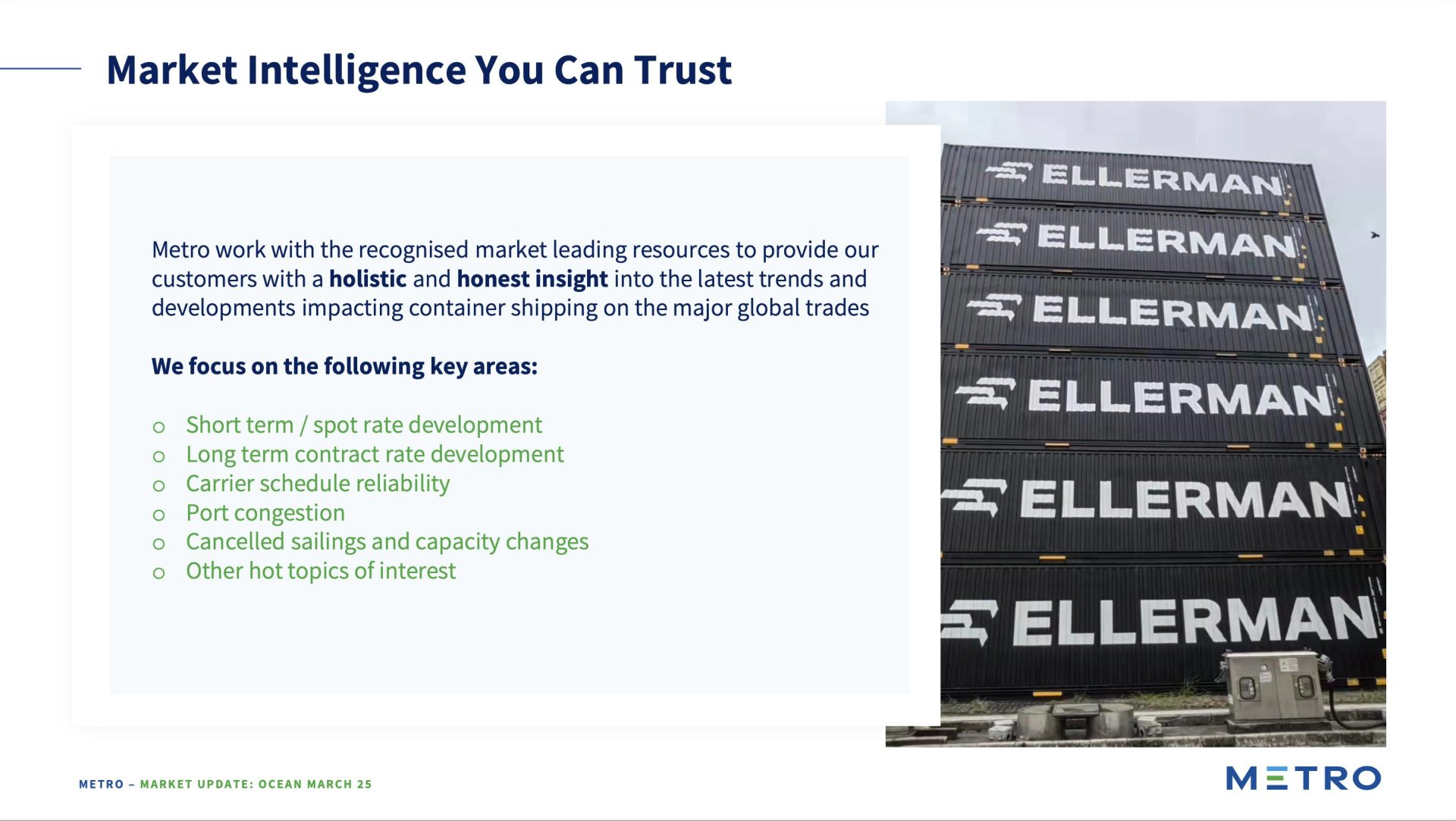
Stay Ahead with Metro’s Ocean Freight Market Update

In the ever-changing world of global trade, staying informed is not just an advantage, it’s a critical necessity. That’s why Metro provides the Ocean Freight Market Update, a comprehensive, data-driven report designed to help businesses navigate the complexities of container shipping.

Subscribers to this monthly report gain valuable insights into spot, short- and long-term rate trends, carrier reliability, port congestion, canceled sailings, sustainability initiatives, and more—ensuring they can make informed, strategic decisions in real-time.

Highlights from the March 2025 Ocean Freight Market Update

Rate Developments: Despite attempts to impose general rate increases (GRIs), rates on Far East Westbound trade lanes have softened. Volatility is expected through April, with Asia-Europe lanes facing capacity shortages.

Schedule Reliability & Port Congestion: Global vessel reliability dipped slightly to 50-55%, while major ports like Singapore, Busan, and Piraeus continue to experience significant congestion.

Bunker & Biofuels Transition: The shipping industry is accelerating its shift toward decarbonisation, but new EU carbon emissions surcharges are increasing costs.

Supply & Demand Outlook: An 8% increase in capacity versus just a 3% rise in demand suggests blank sailings will be necessary to balance market conditions.

Red Sea Transits: Major carriers continue to avoid the Suez Canal due to ongoing security concerns, maintaining Cape of Good Hope reroutes.

Why Subscribe?
Metro’s Ocean Freight Market Update is an unbiased, intelligence-driven resource backed by data from leading industry sources. In a landscape shaped by supply chain disruptions, regulatory shifts, and market fluctuations, having access to timely, expert insight is more critical than ever.

Subscribe now to receive monthly updates straight to your inbox and stay ahead in the dynamic world of ocean freight.

Contact your Key Account Director, or EMAIL Lucy Hulston to subscribe and receive the latest update.