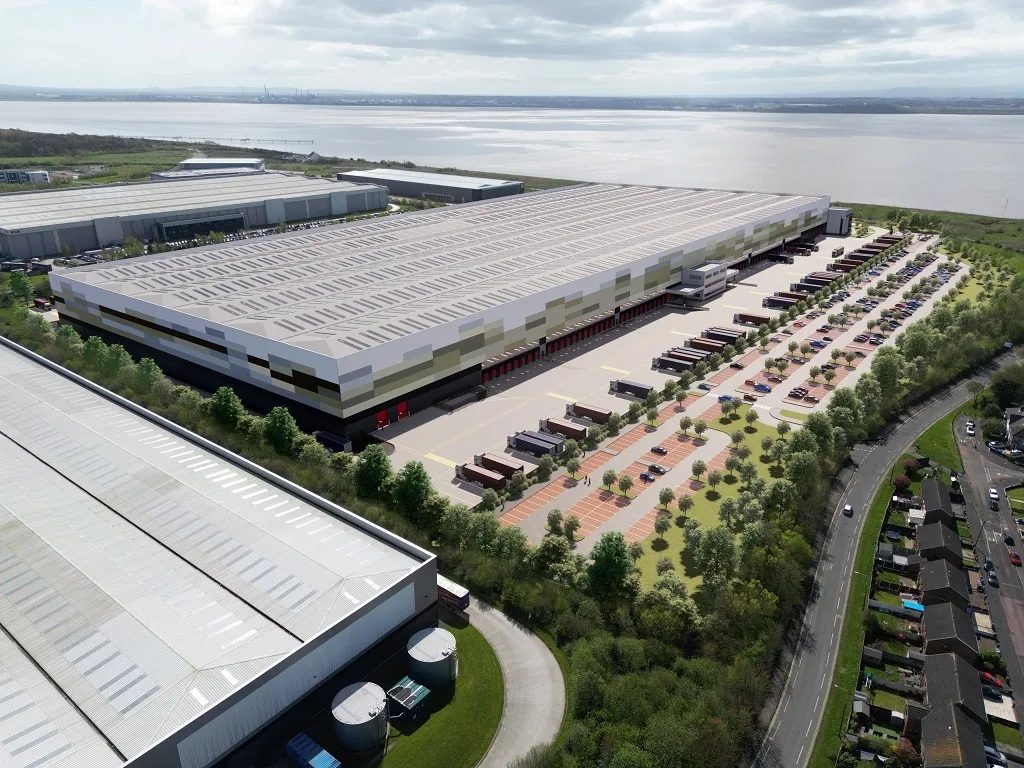
GB Global backs major Liverpool distribution centre

GB Global backs major Liverpool distribution centre

GB Global, Metro’s holding group, is supporting the development of a new 950,000 sq ft multi-user distribution centre in Speke, Liverpool, reinforcing the group’s ability to handle growing and more complex freight flows.

The 50 acre site will accommodate a single cross docked facility of over 950,000 ft2 incorporating 31,000 ft2 of two storey offices, a 902,000 ft2 warehouse as well as two transport offices of 6,000 ft2 and a gatehouse.

The property will have 21m eaves, 118 dock and 12 level access doors as well as 55m yards to both sides and parking for 238 HGVs and 600 cars. The scheme will target BREEAM Excellent and an EPC A+ rating with the warehouse roof being 100% PV ready.

The redevelopment has received planning approval from Liverpool City Council, attracting national attention, including coverage by the BBC, which reflects the strategic importance of logistics infrastructure to regional growth and national supply-chain capability.

An economic impact assessment published by Brookdale Consulting estimates the £96m scheme would generate £42m in business rates over 10 years and create 500 jobs.

Located close to key motorway links, ports and air cargo gateways, the Speke site is designed to support multi-user, multi-sector distribution, offering scale, flexibility and modern facilities aligned with today’s logistics requirements.

For Metro customers, the new Speke facility will:

  • Expand available UK distribution capacity at a time when space remains constrained
  • Support faster inland connectivity between ports, airports and end markets
  • Enable more flexible inventory positioning and fulfilment strategies

As supply chains become more fragmented and risk-aware, access to high-quality, well-located logistics infrastructure is increasingly central to service reliability.

Looking ahead

The Speke development underlines how investment at group level supports stronger execution across the supply chain as a whole. For Metro customers, it reinforces the value of working with a logistics partner that sits within a broader network committed to long-term infrastructure, people and capability.

As supply chains continue to shift from cost-led optimisation toward resilience and performance, this type of strategic investment provides an important foundation for consistent service delivery in the years ahead.

About GB Global

GB Global is a privately owned international group comprising a diverse portfolio of specialist businesses spanning logistics, supply chain, technology, education, customs, consultancy, sustainability, and property development.

Employing over 3,000 people worldwide, the Group operates across all major global markets, delivering fully integrated, end-to-end solutions that connect every stage of the supply chain – from global freight and warehousing to customs compliance, digital trade management and environmental consultancy.

GB Global operates through a network of independently managed specialist businesses, each with its own leadership, expertise and customer focus, supported by shared strategic oversight, investment, assets and group-wide capabilities. This structure enables agility at company level, while providing customers with the scale, resilience and integrated services of a global organisation.

For more information, visit www.gbglobal.world

Smart 2026 supply chains are being engineered for pressure

Smart 2026 supply chains are being engineered for pressure

Supply chains are no longer judged on efficiency alone, in 2026 they will be expected to anticipate disruption and adapt at speed to actively support growth. The experience of the past year confirmed that stability is no longer a realistic planning assumption, but performance under pressure is.

Rather than a single crisis, 2025 delivered constant friction. Congestion resurfaced across ports and inland networks, capacity existed but was selectively deployed, and geopolitical and regulatory shifts altered trade flows long before any formal policy changes took effect. 

The result was a decisive shift in mindset: supply chains must be designed to operate in volatility, not merely recover from it.

That shift accelerates in 2026, as technology, resilience and sustainability converge to redefine how supply chains are planned, financed and executed.

Resilience becomes a competitive advantage

If 2025 proved anything, it was that capacity on paper does not guarantee performance in practice. Across ocean, air and road freight, service reliability was dictated by execution: blank sailings, schedule volatility and inland bottlenecks determined what actually moved.

In response, supply chain design is moving beyond simple continuity planning toward resilience, where networks are designed to adapt and improve under stress.

Common characteristics include:

  • Multi-route and multimodal playbooks rather than single-lane optimisation
  • Near-shoring and regionalisation to shorten lead times and reduce exposure
  • Centralised planning paired with regional execution for faster response

These approaches reflect a broader shift away from cost-minimisation toward risk-adjusted performance.

Warehousing becomes a strategic control point

Warehousing emerged as one of the most critical differentiators in 2025 — a trend that intensifies in 2026. With transit times less predictable and congestion harder to avoid, inventory positioning and fulfilment speed have become central to supply-chain resilience.

High-performing shippers increasingly treat warehousing as an active control layer, not passive storage. Key developments include:

  • Greater use of strategically located facilities to buffer disruption
  • Tighter integration between warehousing, transport and customs planning
  • Investment in automation and robotics that flex with demand and seasonality

This is particularly important as omnichannel and e-commerce pressures continue to grow, demanding seamless support for direct-to-consumer, BOPIS and rapid fulfilment models alongside traditional B2B flows.

From reactive networks to intelligent systems

One of the most significant changes heading into 2026 is the role of technology within supply chains. What began as analytical support is now moving into operational control.

AI-enabled tools are increasingly embedded across planning, procurement, inventory management and risk assessment, enabling supply chains to:

  • Anticipate disruption through predictive insights
  • Optimise routing, inventory and capacity decisions in near real time
  • Coordinate responses across multiple functions and geographies

As these systems become more connected, cybersecurity and data governance also rise sharply in importance. Protecting sensitive operational, commercial and customs data is now a core supply-chain requirement, not an IT afterthought.

Data quality, skills and execution define winners

Technology alone is not enough. The past year also highlighted a widening gap between organisations that could convert insight into action and those constrained by fragmented systems and poor data quality.

In 2026, competitive advantage depends on:

  • Clean, trusted and consistent data across logistics, customs and finance
  • Integrated platforms rather than disconnected tools
  • Teams with the skills to manage AI-driven, data-rich operations

Workforce transformation is therefore as important as digital investment. Roles are evolving toward data analytics, systems oversight and exception management, requiring targeted up-skilling to unlock value from new technologies.

Sustainability and compliance move into the operating core

Environmental and regulatory pressures are no longer peripheral considerations. Carbon pricing, emissions transparency, stricter customs enforcement and evolving trade rules are now shaping routing, mode selection and inventory strategy.

For most shippers, progress in 2026 will come less from premium “green” options and more from practical levers:

  • Smarter planning and consolidation
  • Modal optimisation and regionalisation
  • Stronger traceability and data governance

Sustainability and compliance have become operational constraints — inseparable from cost, resilience and service performance.

Designing supply chains that perform under pressure

Taken together, the direction of travel for 2026 is clear. Supply chains are being rebuilt as intelligent, integrated systems — shifting from reactive cost centres to strategic growth engines.

The most resilient networks are those that:

  • Integrate finance, procurement, logistics and technology decisions
  • Combine centralised control with regional agility
  • Invest equally in data, platforms, people and process

The objective is not to eliminate disruption, but to design networks that continue to perform when conditions are uncertain.

At Metro, this same mindset underpins how supply chains are assessed and supported. Stress-testing assumptions, strengthening visibility and applying execution-focused logistics, warehousing and transport strategies. In 2026, the differentiator will not be avoiding disruption, but owning a supply chain designed to operate through it.

Road freight market sees failure and consolidation

Road freight market sees failure and consolidation

The UK road freight market is facing severe pressures from rising operational expenses and ongoing labour shortages, with Q3 rates surging 10% year-on-year, reflecting widespread cost increases.

This tough economic climate has led to the failure of nearly half of all haulage companies launched between 2019 and 2023, with fierce competition and volatile costs proving too much for smaller operators. Over 50,000 firms have exited the market, particularly in the container freight sector, with many drivers moving to alternative industries.

The failures of these smaller firms have opened the door to consolidation within the market. One of the most significant moves is MSC’s acquisition of Maritime Transport, the UK’s largest haulier. Maritime Transport operates a fleet of 1,600 trucks and has a significant presence at major UK ports.

MSC’s acquisition is part of a wider strategy to consolidate control of overland logistics throughout Europe and is likely to raise concerns among other shipping lines, potentially reshaping customer relationships in the industry.

Simultaneously, hauliers are dealing with significant challenges at UK ports. While DP World’s £1bn development of new berths at London Gateway is progressing, there are continuing political tensions between the operator and UK government officials.

Construction of two new berths will go ahead as part of a long-term plan to make London Gateway the UK’s largest container port, potentially handling six ultra-large container vessels simultaneously by the end of the decade. This expansion will significantly increase capacity and create around 400 new jobs.

Elsewhere, other UK ports are facing infrastructure delays, which are putting essential development projects at risk. The British Ports Association (BPA) has raised concerns over the backlog of harbour orders that ports require to make infrastructure upgrades and expand capacity. These delays threaten billions of pounds in investment and the ability of ports to meet growing trade demands. The situation is particularly dire for ports like Southampton and Plymouth, which have been waiting years for regulatory approvals to begin critical development work.

As the road freight industry faces these mounting pressures, larger operators are increasingly consolidating power while smaller firms struggle to survive.

The efficiency of the haulage sector remains dependent on the performance and expansion of the UK’s key ports, where delays and congestion could have far-reaching implications for supply chain resilience.

Metro offers secure road transport solutions with dedicated vehicles running on fixed routes, ensuring timely deliveries and GPS tracking for full visibility across the UK and continental Europe.

Our road freight teams are strategically located near major manufacturing and transport hubs throughout the UK, enabling efficient logistics support.

To learn more about our domestic and European services, please EMAIL Richard Gibbs to start a discussion tailored to your specific needs.

Ukraine invasion drives timber prices up and pallet supply down

Ukraine invasion drives timber prices up and pallet supply down

The European Pallet Association (EPAL) and the European Federation of Wooden Pallet and Packaging Manufacturers (FEFPEB) have warned of a shortage of wooden pallets and packaging that is already being felt.

The war in Ukraine and the shutdown of production is having serious consequences for European pallet manufacturers, with packaging prices increasing, as evidenced by a French trade association who confirm that pallet prices have risen from €7 to €29, an increase of >400% increase.

The associations said that pallets are increasingly difficult to find and more expensive to produce in a context of soaring raw material costs and in particular the price of wood.

Pallets are critical components in the global transportation, because they are the common interface for every stage – handling, shipping, trucks, forklifts – and make the supply chain work. They have become a key component of transport and warehousing especially over the last few decades and are an essential tool to  industry. What you see in your local supermarket on a shelf has invariably been on at least one pallet in its movement, and usually several.

Without pallets, supply chains would revert to handling one box at a time, which is the way cargo moved, before the pallet was introduced over a hundred years ago.

Ukraine exported over 2.7 million m³ of lumber last year, a significant part of which was used for the production of wooden pallets and packaging in Europe, while Ukraine also independently produced and exported to European states about 15 million of its own locally manufactured pallets.

In addition to stopping deliveries from Ukraine, the wooden pallet and packaging market will also face difficulties with imports from the Russian Federation and Belarus, which annually supplied about 7.6 million m³ of lumber to the EU – that’s a huge amount of timber boards to be extracted from the supply chain.

Alternative suppliers from Scandinavia, Germany and the Baltic countries are currently not yet able to fully cover the possible shortage.

The result, for companies further down the line, is a sudden rise in pallet prices and the risk of running out of a product that’s often overlooked yet essential to supply chains, as it allows businesses to stack goods and transport them efficiently with reduced loading time. This affects all modes of transport, from high value electronic goods by air freight, through to foodstuffs by truck. Something to be aware of, that will add to the cost of goods.

To discuss your packaging and pallet requirements, please contact our export team, who can take you through your options and solutions. If you are seeing a shortfall in supply from current suppliers of pallets we have a network to recommend and assist with, what will hopefully be, a short term challenge that will often not be considered as a problem.