HKG port

Peak season uncertainty grows as shippers front-load inventory and freight demand diverges

Container shipping markets appear to be entering an earlier and increasingly fragmented peak season, as geopolitical disruption, rising fuel costs and tighter carrier capacity management reshape freight demand across major trade lanes.

Bookings on several east-west corridors strengthened earlier than normal during May, with carriers maintaining upward pressure on rates as many importers accelerate shipments ahead of the traditional third-quarter peak season period.

Spot rates on Asia–US west coast services have continued to outperform other major trades, rising around 4% week on week and remaining significantly above levels seen before the escalation of Middle East disruption. Asia–Europe pricing has also strengthened modestly, with rates to North Europe and the Mediterranean increasing as carriers attempt to restore margins through capacity reductions and surcharge increases.

However, broader market conditions remain difficult to interpret. What appears to be an early peak season may ultimately reflect precautionary inventory positioning and front-loading activity rather than sustained end-user demand growth.

Front-loading and disruption are reshaping traditional shipping patterns

A growing number of importers are moving cargo earlier amid concerns that operational disruption, congestion and capacity shortages could intensify later in the year.

The continuing closure and instability surrounding the Strait of Hormuz is adding further pressure to global freight markets, with around 1.5% of global shipping capacity estimated to be affected directly by disruption linked to the region.

At the same time, higher oil prices are increasing carrier operating costs across both ocean and airfreight markets, while blank sailings are continuing to tighten effective capacity on key trades.

Capacity reductions on Asia–Europe services have become increasingly aggressive in recent weeks, with shipping lines reducing available space to North Europe and the Mediterranean while also introducing additional blank sailings beyond traditional holiday periods.

The result is a more volatile market where shipment rollovers, reduced allocations and short-notice schedule changes are becoming increasingly common, even where bookings are technically available.

On transpacific trades, carriers have also maintained relatively firm control over available capacity following post-Lunar New Year service adjustments, helping sustain pricing despite ongoing uncertainty around underlying consumer demand.

Additional surcharges introduced on Asia–US services suggest carriers expect demand to remain comparatively elevated through the summer period.

Many importers remain cautious about underlying demand, particularly in Europe where economic conditions remain comparatively weak and pressure on household spending continues to affect purchasing behaviour.

This creates the possibility that some businesses could be holding elevated inventory levels later in the year, potentially resulting in a delayed, compressed or weaker traditional peak season across certain sectors.

Metro survey highlights cautious but stable demand expectations

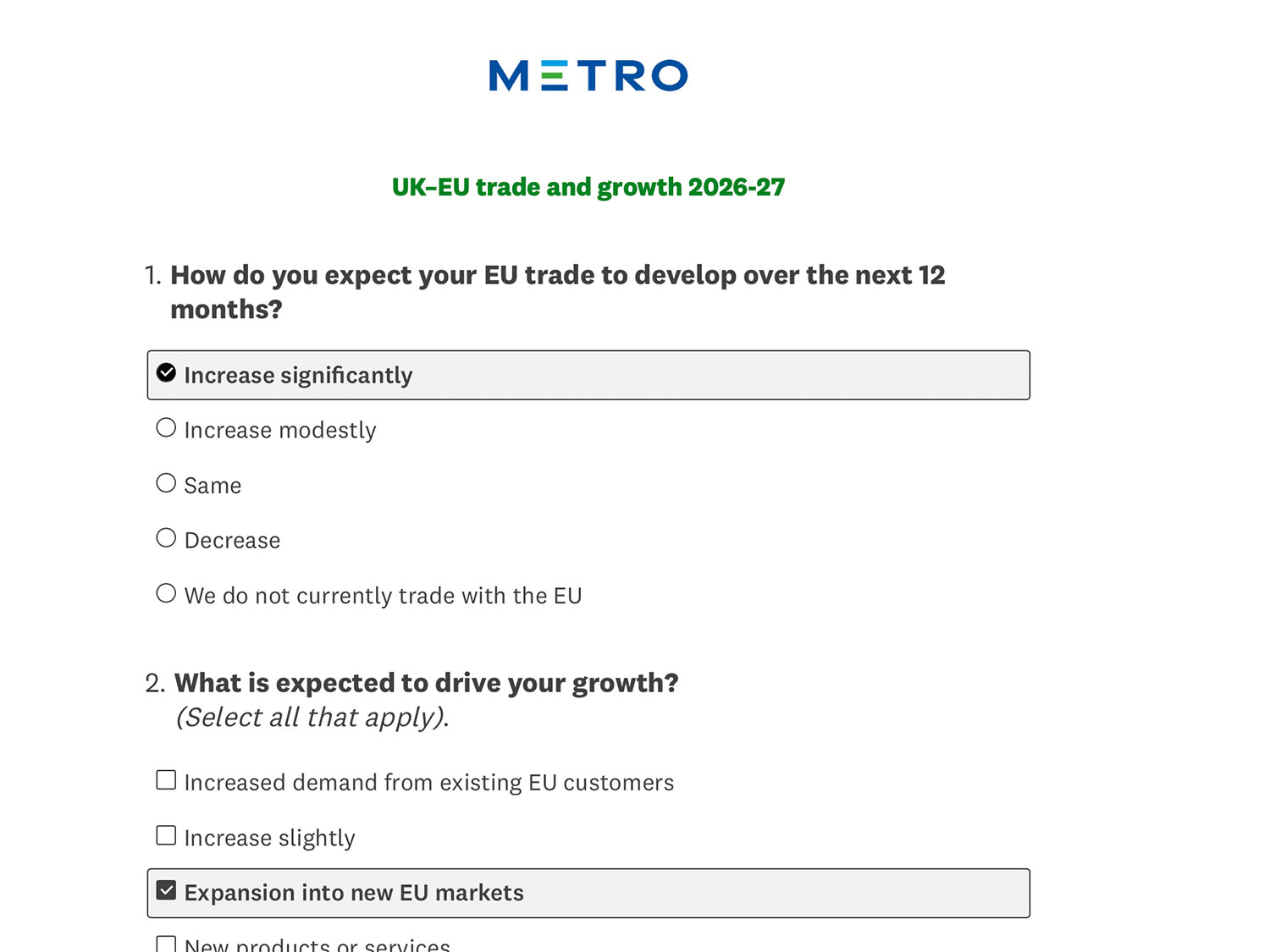
Early findings from Metro’s ongoing customer survey reflect this more balanced outlook.

Around 38% of respondents currently expect freight volumes to remain broadly stable over the next 12 months, while a similar percentage expect volumes to increase slightly. Less than 1/8 anticipate a significant decrease, while none expect a significant increase in activity.

The findings suggest that many businesses are not currently anticipating a dramatic peak season surge, but instead expect relatively stable trading conditions alongside continued disruption and cost pressure.

At the same time, respondents indicate that ongoing instability across global supply chains is continuing to influence inventory planning, shipping schedules and freight costs.

The divergence between Asia–US west coast and Asia–Europe markets highlights how uneven global freight conditions have become. Rather than moving in a single direction, pricing and demand are increasingly being shaped by regional economic performance, inventory strategies and trade lane-specific operational risks.

Sea–air solutions gaining attention as airfreight costs surge

The disruption is also influencing modal shift decisions.

With the average airfreight rate out of Asia-Pacific over 40% higher than last year shippers are increasingly exploring sea–air solutions to balance cost, speed and reliability.

Airfreight rates have risen sharply as fuel surcharges, restricted airspace and tighter capacity continue to affect global networks. At the same time, ongoing Red Sea diversions are keeping some ocean transit times above 50 days on Asia–Europe services.

For many retail, fashion, e-commerce and consumer goods shippers, sea–air services are becoming an increasingly valuable tactical solution where traditional airfreight costs are difficult to absorb but ocean transit times remain commercially challenging.

For shippers, the key challenge may now be timing. If front-loading activity continues through the early summer period, demand on some corridors could remain firmer for longer than normally expected. However, weaker consumer demand and elevated inventory levels could also limit the scale of any traditional late summer or autumn rebound.

Metro’s survey remains open, and businesses are encouraged to share their expectations and experiences, together with insights into current market conditions, operational pressures and changing supply chain requirements. The survey also provides an opportunity for customers to share feedback on Metro’s performance and highlight where additional support or solutions could help strengthen supply chain operations. 

Through proactive capacity planning, multimodal air, sea and sea-air routing options and contingency-focused supply chain support, Metro helps customers respond more effectively to disruption, changing demand patterns and ongoing peak season uncertainty. EMAIL Managing Director, Andrew Smith, to learn more.

Graph and pound coins 1440x960 1

UK Financial Outlook: Impact of Middle East Tensions

Global freight markets remain heavily influenced by instability across the Middle East, with disruption to ocean and air networks sustaining elevated costs, longer transit times and growing operational volatility. 

Restricted energy flows are continuing to drive sharp increases in bunker and jet fuel pricing, while reducing effective transport capacity well beyond the Gulf region.

For the UK, the impact is particularly significant. As a major energy importer, the economy remains highly exposed to rising oil and gas prices, with the resulting cost pressures now feeding rapidly into logistics, manufacturing and wider financial markets.

Oil prices have risen sharply in recent months, while UK gas prices have also moved significantly higher. This has renewed inflationary pressure across the economy, increasing transport and supply chain costs while also pushing up the price of consumer and industrial goods.

The current environment increasingly mirrors the energy shock seen in 2022, although the transmission through financial and logistics markets is now occurring more quickly due to the continued fragility and interconnected nature of global supply chains.

At the same time, wider economic indicators remain mixed. UK manufacturing activity strengthened in April, with the PMI rising to 53.7, its highest level since May 2022, supported by improved domestic and export demand. However, supply chain pressure intensified sharply during the same period, pushing input costs higher and weakening overall business confidence.

Consumer and industrial sentiment also remains cautious, with inflation concerns, higher utility costs and geopolitical uncertainty continuing to weigh on demand expectations and investment appetite.

Higher borrowing costs and weaker confidence

Financial markets have reacted quickly to the worsening outlook. At the start of 2026, expectations centred around a gradual cycle of UK interest rate cuts. That narrative has now shifted materially, with markets increasingly pricing in a “higher for longer” interest rate environment as policymakers attempt to manage renewed inflation risks.

The Bank of England now faces a difficult balancing act. Much of the inflationary pressure is externally driven by energy disruption and supply constraints, meaning higher interest rates alone cannot resolve the underlying cause. However, allowing inflation to remain elevated risks embedding longer-term cost pressures across the wider economy.

As a result, expectations for rate reductions have largely been pushed back, while the possibility of rates remaining elevated for an extended period has increased significantly.

Currency and bond markets are also reflecting growing uncertainty. Sterling has become more volatile as investors weigh higher UK interest rate expectations against concerns around weaker growth and rising import costs. Meanwhile, UK gilt yields have risen sharply, increasing borrowing costs across government, corporate and household sectors.

For businesses, the implications are becoming increasingly clear. Rising fuel and transport costs are creating additional margin pressure at the same time as higher financing costs reduce investment flexibility and increase operational risk.

In logistics markets, these pressures are compounding existing disruption across freight networks. Longer transit times, volatile routing conditions and elevated operating costs are continuing to affect ocean, air and road freight movements, reinforcing the need for greater agility and contingency planning across supply chains.

Planning for continued volatility

Much will now depend on the duration of disruption across the Middle East and the trajectory of global energy prices. A stabilisation in energy markets could help ease inflationary pressure later in the year. However, any prolonged restriction to energy flows or escalation in regional tensions is likely to sustain upward pressure across fuel, transport and borrowing costs.

For UK businesses, the operating environment is increasingly being shaped by geopolitics as much as underlying demand. Preparing for continued volatility, tighter financial conditions and more complex supply chain risks is therefore becoming a central part of operational and commercial planning.

Metro continues to support customers with flexible routing solutions, multimodal freight options and proactive supply chain planning designed to help businesses respond more effectively to changing market conditions, rising cost pressure and ongoing disruption across global transport networks.

To discuss how current economic and supply chain conditions could impact your business, EMAIL Laurence Burford, Chief Financial Officer.

refinery

Fuel shocks across ocean, air and road freight

With the Strait of Hormuz effectively closed, crude oil can still exist within the region, but refined products, which includes marine fuel, jet fuel and diesel, can no longer move freely to key consumption markets, which has triggered a sharp divergence in pricing and availability across all modes. 

For shippers, this creates a higher cost floor, as transport fuels are no longer moving in line with crude. Marine bunker, jet fuel and diesel each have their own supply chains and crack spreads (the margin between crude and refined products), and are now behaving independently of Brent. This is driving bunker-led cost pressure in ocean, jet fuel-driven inflation in air, and diesel-driven cost escalation in road. 

Ocean freight: bunker costs reset the pricing floor

In ocean freight, bunker fuel has become the dominant cost driver. Asian fuel hubs, particularly Singapore, are experiencing significant pressure as rerouted vessels increase demand while supply remains constrained.

This has created a disconnect between traditional pricing mechanisms and real-time costs. 

Emergency bunker surcharges are being applied across major trade lanes, while standard adjustment factors lag behind market conditions and may only catch up with current fuel inflation later in the year.

The result is a structurally higher cost base, with ocean rates now reflecting fuel volatility rather than underlying demand alone. 

Air freight: jet fuel shortage tightens capacity

Air freight is facing the most acute fuel-driven pressure. Gulf refineries, which typically supply jet fuel to Europe and Asia, are unable to export at normal levels, creating a shortage of refined product.

This has driven a sharp increase in jet fuel prices, with crack spreads widening dramatically from around $16 per barrel pre-crisis to approximately $100 in some regions. 

This regional price divergence means that Asia and Middle East jet fuel benchmarks sit substantially above North American levels, meaning that every kilo of freight uplifted is starting from a materially higher fuel cost base. 

As a result, airlines are adjusting networks, reducing marginal capacity and prioritising fuel efficiency, tightening available uplift and sustaining elevated airfreight rates.

Road freight: diesel inflation feeds through to transport costs

Road freight is also seeing significant cost pressure, with diesel prices rising independently of crude due to refinery constraints and regional supply dynamics.

Fuel accounts for roughly 30% of total truck operating costs, meaning sustained diesel inflation is already feeding through into pricing. 

At the same time, increased reliance on overland routes across the Middle East is adding further demand pressure, compounding both cost and capacity challenges.

What this means for shippers

  • Expect fuel-driven cost volatility across all modes
  • Plan for longer and less predictable transit times
  • Build flexibility into routing and inventory strategies
  • Monitor surcharge mechanisms

Fuel disruption, routing constraints and capacity pressure are now closely linked. Managing one without the others is no longer effective.

Metro works with customers to model alternative routes, balance mode selection and manage cost exposure in real time. If you are seeing rising costs, delays or uncertainty in your supply chain, EMAIL managing director, Andrew Smith, to secure the most effective solution for your cargo.

City of London 1440x1080 1

Economy slows as supply chain disruption and energy costs hit

The UK economy is showing clear signs of slowing, with growing pressure on importers and exporters, as supply chain disruption and rising energy costs begin to feed through. 

While headline indicators suggest marginal growth, underlying conditions point to a more fragile environment, which is shifting the focus towards control and adaptability, with forward planning, flexible routing and improved visibility becoming key to maintaining performance.

Demand moderates but remains supported by structural activity

The latest PMI data is still expanding, with the composite index at 51.0 marking eleven consecutive months of growth. However, the pace has slowed, and business confidence has eased to a nine-month low.

UK GDP was flat in January, with three-month growth of 0.2%, reflecting a slowdown rather than a contraction. More recent data suggests goods sectors are losing momentum, but activity remains in expansion territory.

Manufacturing output in March edged close to stagnation (50.1), while overall activity continues to expand, marking an extended period of growth. Demand patterns are becoming more selective, with some buyers delaying orders due to cost pressures, while others are maintaining or even accelerating purchasing to secure supply.

Export demand remains mixed, but still present. Some manufacturers reported modest increases in overseas orders, supported in part by customers bringing forward purchases and building inventory to mitigate future disruption.

This points to a market that is not weakening uniformly, but instead becoming more dynamic, with pockets of resilience alongside more cautious spending.

Input costs rise sharply, reinforcing the need for supply chain control

Cost pressures are accelerating across goods sectors, driven by higher fuel costs, transportation charges and energy-intensive inputs.

Manufacturing input prices recorded their sharpest increase in over three decades, with around 47% of firms reporting rising costs. This is feeding through into output pricing, with manufacturers increasing selling prices at the fastest rate since April 2025.

At the same time, supply chains are becoming less predictable. Around 25% of manufacturers reported longer supplier delivery times in March, reflecting extended transit times from Asia and disruption linked to rerouting and network congestion.

While these pressures are significant, they are also increasingly visible and measurable. For many businesses, this creates an opportunity to take earlier action, whether securing capacity in advance, adjusting routing strategies or reviewing supplier and inventory models to reduce exposure.

Interest rate outlook shifts as inflation risks re-emerge

At its latest meeting on 19 March, the Bank of England’s Monetary Policy Committee voted unanimously to hold the base rate at 3.75%, in line with expectations.

While acknowledging signs of weaker economic activity, policymakers highlighted the risk that rising energy costs could feed into wages and domestic pricing. The Committee signalled a more cautious stance, removing earlier guidance that pointed towards rate cuts and instead emphasising a readiness to act if inflationary pressures strengthen.

Markets interpreted the shift as a more hawkish tone, suggesting that borrowing costs may remain higher for longer if energy-driven inflation persists.

For goods-focused businesses, this reinforces the need to manage both cost inflation and financing conditions, particularly where inventory and working capital requirements are increasing.

Inventory strategies shift as businesses balance risk and demand

Changing conditions are driving a more proactive approach to inventory management. Some businesses are increasing stock levels and bringing forward orders to protect against future disruption, while others are taking a more cautious approach in response to cost pressures.

This is creating more uneven demand patterns, but also supporting short-term volume in key sectors. At the same time, inventory levels remain relatively tight overall, reflecting the ongoing impact of supply chain delays.

For supply chains, this reinforces the importance of flexibility — balancing stock availability against cost, while maintaining the ability to respond quickly as conditions change.

US and EU markets provide stability, but cost pressures remain a factor

The United States and EU continue to provide relatively stable demand conditions, supporting UK trade flows.

US inflation remains moderate at 2.4%, with interest rates held at 3.50%–3.75%, while the EU is close to target at 1.9%. These conditions are helping to sustain demand, even as global uncertainty increases.

However, both markets remain exposed to rising energy costs, which could influence pricing and demand if sustained. For UK exporters, this means opportunities remain, but with increasing sensitivity to cost and lead time.

Stay ahead of changing conditions with Metro

Metro helps importers and exporters turn market complexity into a controllable, manageable process.

Whether adapting to rising costs, mitigating supply chain delays or optimising inventory flow, Metro provides the insight and operational support needed to maintain performance in a changing market.

To discuss how current economic and supply chain conditions could impact your business, EMAIL Laurence Burford, Chief Financial Officer.