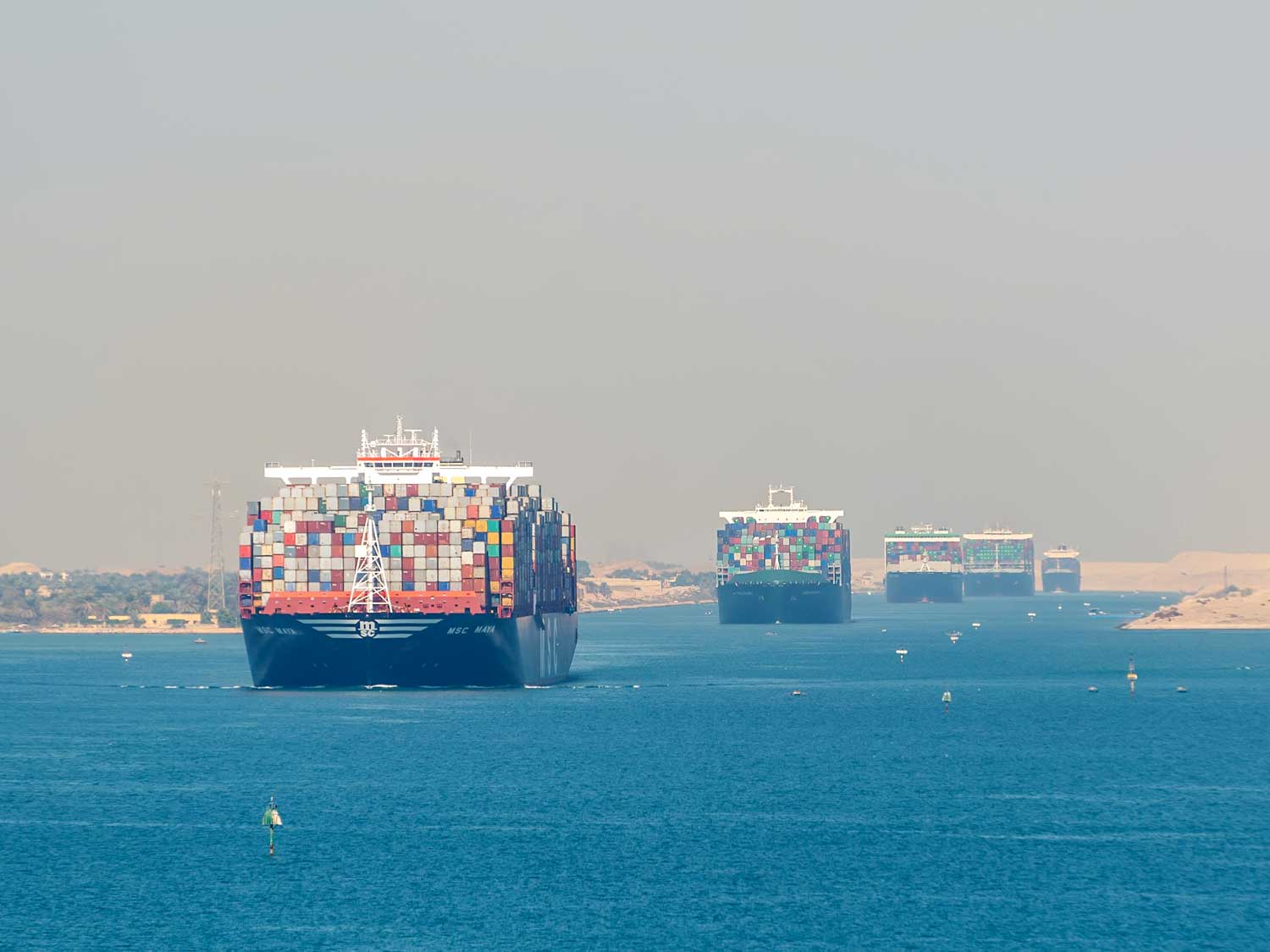
Nearly two-thirds of Far East–Europe container shipping capacity is now operating through the Red Sea and Suez Canal, marking a significant shift away from Cape of Good Hope diversions, although security concerns and changing service rotations mean the return remains uneven.
After almost three years of widespread diversions around southern Africa, container shipping is progressively returning to one of the world's most important trade corridors.
Major shipping lines have restored Suez transits across a growing number of Asia–Europe services, with the recovery now extending to selected routes connecting Asia and the US East Coast.
The transition could shorten delivery times, reduce fuel consumption and eventually release substantial vessel capacity. However, mixed routings, ongoing security assessments and potential congestion at European ports mean the benefits will not be immediate or consistent across every service.
Nearly two-thirds of Asia–Europe capacity returns
The scale of the recovery is becoming increasingly clear.
Analysis of the ten largest container shipping networks shows that approximately 5.5 million TEU of the 8.7 million TEU deployed between the Far East and Europe is now assigned to services using the Red Sea.
The Mediterranean trades are leading the recovery, with around 70% of capacity back on Suez routings, compared with 58% on Far East–North Europe services.
However, the return is not uniform.
Some services use the Suez Canal westbound towards Europe but continue to route eastbound voyages around the Cape of Good Hope.
This approach allows carriers to reintroduce shorter routings selectively while retaining flexibility if regional security conditions deteriorate.
Major carriers accelerate their return
The shift has gathered momentum since the summer, with several major shipping groups progressively restoring services.
MSC resumed Suez transits in August and now operates 11 loops through the waterway, representing approximately 2.2 million TEU of deployed capacity.
Maersk and Hapag-Lloyd have also expanded their use of the route, with nine alliance services representing around 1.76 million TEU.
CMA CGM maintained a presence through the Suez Canal during the disruption and has subsequently expanded its operations, while COSCO and OOCL have restored six services with combined deployed capacity of approximately 1.27 million TEU.
The Premier Alliance has also begun returning selected services, adding further momentum.
With some networks operating through Suez in both directions, others retaining Cape diversions, and several using different routes for outbound and return voyages, individual service patterns remain important when assessing transit times and reliability.
Weekly Suez traffic continues to strengthen
The recovery is also evident in actual canal traffic. Containership transits increased from 54 in week 41 to 55 in week 42, extending a period of improving volumes.
The latest figures indicate that more carriers are progressively restoring services rather than relying solely on occasional voyages.
However, the canal remains well below its historical potential, and the return is taking place against a backdrop of continuing security concerns around the Red Sea and Bab-el-Mandeb Strait.
For shipping lines, the commercial advantages of Suez are substantial. Shorter voyages can reduce fuel consumption, lower operating costs and potentially allow carriers to maintain weekly services with fewer vessels.
With bunker prices remaining elevated, these savings provide a strong incentive to restore shorter routes wherever security assessments permit.
Asia–US East Coast services begin returning
The recovery is no longer confined to Europe. MSC and Zim have resumed Suez transits in both directions on their shared Asia–US East Coast service, marking a further development in the restoration of global shipping networks.
The first northbound sailing departed Singapore on 18 October, with arrival in New York–New Jersey expected on 18 November.
Other services connecting India and the Middle East with the US East Coast have also resumed Suez routings, although some continue to use the Cape of Good Hope in the opposite direction.
For shippers, the potential transit-time benefits vary considerably. Asia–Europe services returning to Suez have achieved average transit-time improvements of approximately seven days.
However, North American services have experienced mixed results, with some achieving modest savings and others recording longer overall transit times despite using the shorter canal route.
Port rotations, transhipment arrangements and congestion at intermediate gateways can offset the theoretical advantages of a shorter voyage.
Full return could happen in early 2027
Industry expectations increasingly point towards a broader restoration of Suez services during the first quarter of 2027.
However, this remains a scenario rather than a confirmed timetable.
Maersk has discussed the possibility of further service returns, but has emphasised that no definitive schedule has been announced and that future changes will depend on security conditions, operational planning and consultation with partners and customers.
The pace of recovery will also depend on the ability of ports and inland transport networks to accommodate changing vessel arrival patterns.
Rotterdam and Antwerp-Bruges are already experiencing challenges associated with overlapping schedules and fluctuating volumes as services transition between Cape and Suez routings.
A faster return could release significant effective vessel capacity into the market, potentially increasing pressure on ocean freight rates.
At the same time, changes to vessel rotations and arrival patterns could create temporary congestion, schedule disruption and equipment imbalances.
Changing ocean networks offer supply-chain opportunities
The return to Suez could reshape ocean freight costs, transit times and capacity availability. Making the most of these changes requires accurate market intelligence and the flexibility to respond.
Our teams monitor carrier routing decisions, vessel schedules, port conditions and freight rates, identifying opportunities to improve transit times, manage costs and maintain reliable delivery performance.
Whether you're reviewing Asia–Europe or trans-Pacific shipping arrangements, evaluating India–US connections or preparing for further network changes in 2027, Metro can help you understand the implications and identify practical alternatives.
Contact Metro to review your ocean freight strategy and take advantage of emerging routing, capacity and cost opportunities as the Suez Canal recovery gathers pace.