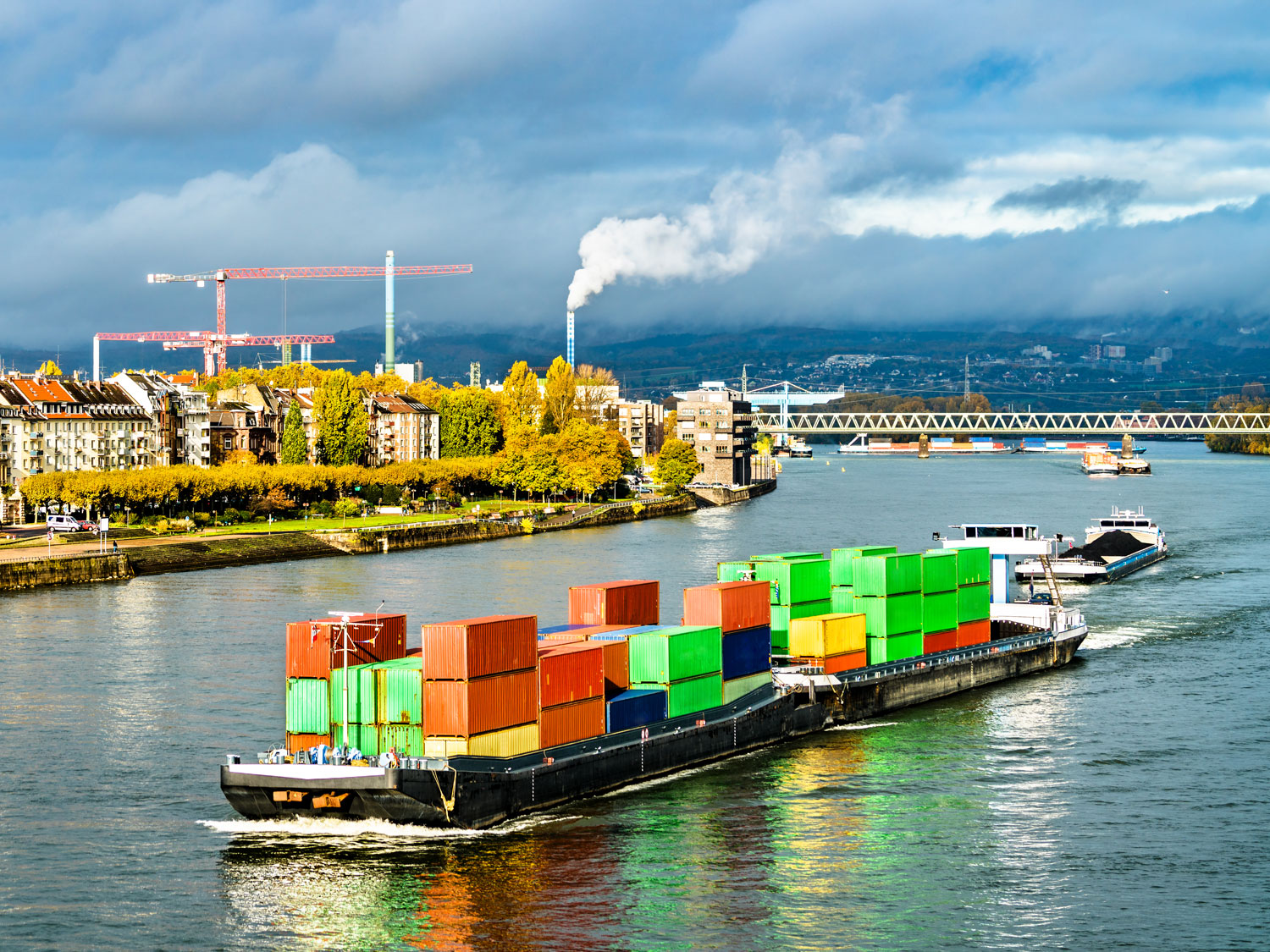
Rhine barge

Rhine closure to container barge traffic will have far reaching consequences

Europe’s heatwave forced the closure of the Rhine to barge traffic from last Friday as water levels fell 4cm below the depth necessary for operations, raising fears for container shipping and industrial disruption.

The Rhine, the second-largest river in central and western Europe, runs 760 miles from the Swiss Alps to the North Sea, with significant container volumes moving between Rotterdam, Antwerp, Germany and Poland.

The depth of the Rhine was down to 49cm on 7th August at the gauge tower at Kaub, a bottleneck widely considered to be the most important point for navigators assessing depth. At 41cm the river becomes all but impassable and the river dropped to 37cm on 13th August. 

Levels at the Kaub chokepoint are lower than they were at the same point in 2018 ahead of that October’s historic low of 25cm. The water was so low the river was closed to ship traffic for weeks, forcing companies to switch freight to railways and roads.

Millions of tonnes of containers and conventional cargoes are shipped on the Rhine and any drop in capacity will hit industrial production. Similar drought conditions in 2018 saw production drop by 1.5%.

Operators have been running services at 20% capacity (which has already generated a containerbacklog) to reduce the depth they require, but with water levels dropping a further 5cm over the weekend, they have had to discontinue navigation on the Upper and Middle Rhine.

The river’s closure has come at an already challenging time for European supply chains, which are dealing with continuing port congestion, the repercussions of the war in Ukraine and increasing industrial unrest.

The most unfortunate shippers will be wondering how they can retrieve containers already out on barges when the closure was announced and get them to the nearest terminals for unloading.

Barge operators say they will position vessels to safely unload containers at terminals and move overland between the terminals on the Upper, Middle and Lower Rhine, although this is not assured, as there are fears that water levels could fall well below 27cm record and switching from barge to rail brings a premium, which can be substantially more to move goods by road.

Please read the attached link to Loadstar with an informative article from last week in the prominent trade press that provides further details - https://theloadstar.com/rhine-closure-imminent-as-low-water-hobbles-freight-movement-by-barge/

The UK and Europe's supply chains are being hit with many unimaginable challenges over recent months that will continue in 2022 and 2023. Metro will always be at the front of the industry and leading innovation and initiatives to ensure that we work around issues and deliver the best available and competitive solutions within any environment regardless of the reason for the disruption.

The impact of the Rhine’s closure to barges will not directly impact many of our customers, but the knock-on impact to continental container ports could be profound and may impact traffic diverted from Felixstowe, in light of next week’s strike.

We are closely monitoring the situation in Germany and other affected countries and how it extends to European ports, because delays and congestion there may impact the repatriation of cargo and UK vessel calls, with extended overall transit time.

For further advice and updates, please call your Metro team. We will provide the latest information and options, to ensure your product is delivered to the right place at the right time, competitively. It’s what we do.
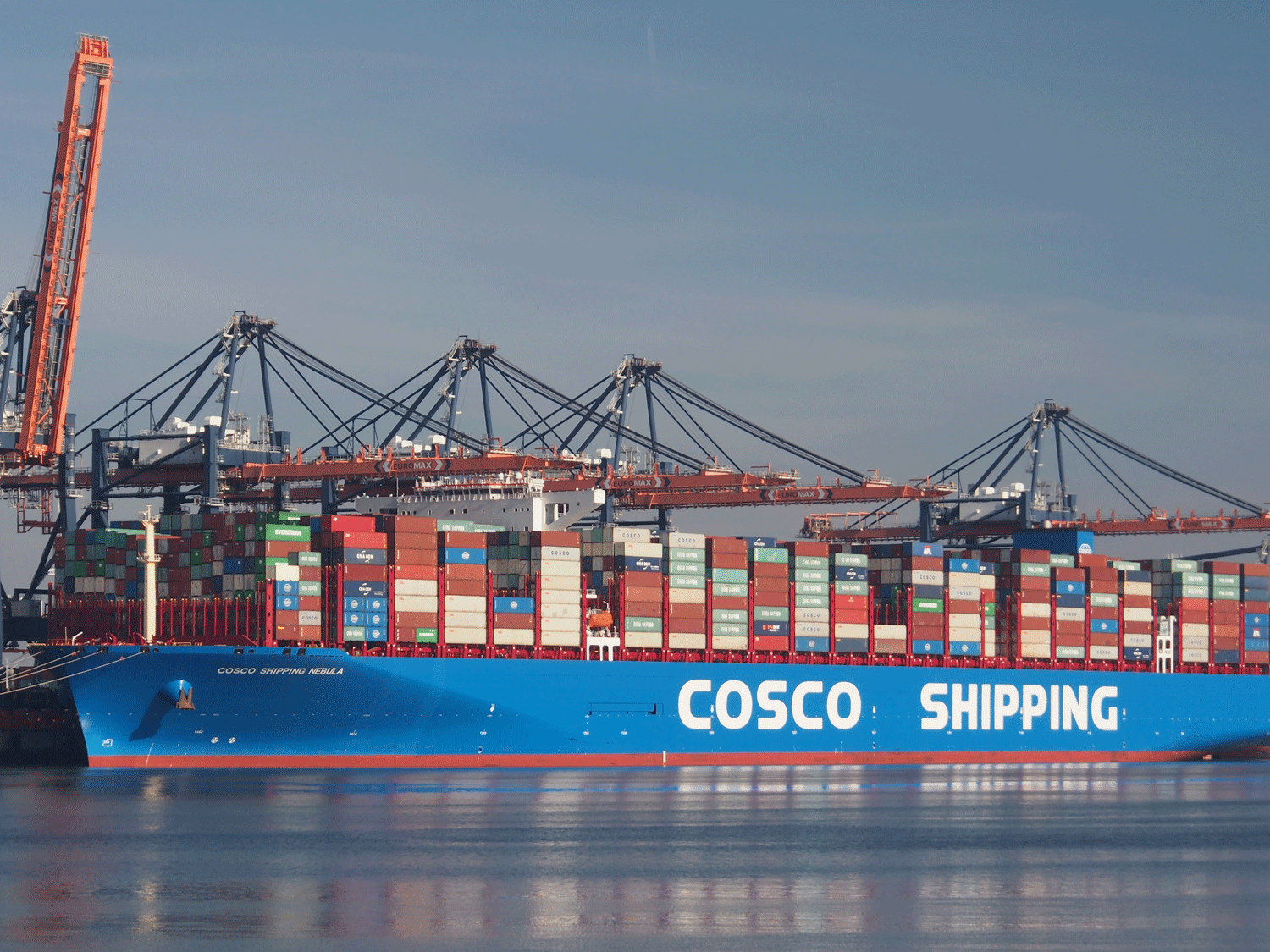
COSCO appoint Metro partner

More blank sailings show wisdom of mixed rate portfolio

As we enter the traditional peak season for sea freight, demand for space from China is falling and the lines are taking action to counter over-capacity in the North Europe and Mediterranean trades, while transPacific demand in stasis.

As Hapag-Lloyd published its Q2 2022 results, the impact of increasing contract rates in 2022 is clear, with more record breaking profits and average freight rates up 70% year-on-year, even with the supply/demand equation shifting in favour of the shipper. 

The overall picture is mixed, with rates on some routes experiencing downward pressure, while continuing port congestion has reduced the amount of effective capacity, which stops rate erosion on others. Most notably on the Asia-North Europe trade lane, where major hub ports are suffering a combination of increased import dwell times, labour shortages and industrial action.

Ocean carriers will be looking to blank as much capacity as possible in the short term, to move the supply/demand equation back in their favour.

While no blanking details have emerged, research by Sea-Intelligence has found that certain sailings crop up repeatedly, when it came to blank sailings from Asia to North Europe.

The Danish analysts measured the average number of weeks between a blank sailing on each respective service, to identify those most at risk of blanking.

2M’s AE5/Albatross and AE10/Silk were blanked once every 9-13 weeks in the last 12 months, while AE55/Griffin and AE6/Lion were blanked every 5-6 weeks in the last 12 months.

Ocean Alliance’s AEU2 and AEU6 were hardly blanked in the last 12 months, while AEU7, AEU9, and AEU1 were blanked every 5-7 weeks, while THE Alliance services, were all blanked quite frequently.

Carriers favour certain services, either by virtue of value, routes, or the ports that they call at and knowing which services are more likely to be blanked help us limit disruption to our clients’ supply chains.

To move cargo on specified vessels and routes, in the most efficient and cost-effective method, we apply the most beneficial pricing model for our customer, which may be based on contracts, FAK or spot rates.

We negotiate annual volume and rate contracts across the three alliances, primarily for the largest shippers, who need pricing stability and the best space guarantees.

Freight All Kinds (FAK) pricing allows us to leverage our buying power, to get competitive rates from individual shipping lines on a variety of routes, locked-in for a specified period.

The spot-rate market can offer the lowest rates, but it applies to individual sailings and needs to employed with caution, to minimise instability. It is by far the most unpredictable pricing model, with significant risks, such-as cargo rolling, which may result in financial and transit penalties.

We negotiate long-term and FAK contracts with shipping lines across all three alliances to secure space and rates, to provide the best alternatives and options, whatever the situation.

By leveraging agreements across the alliances - and spot rates, when appropriate - we can often adapt port pairs and routings, to work around blanked sailings, to maintain resilient and reliable supply chains.

FRBNY

Supply chain pressure index falling

Tensions across the Taiwan Strait are not good news for global supply chains, but after what has arguably been the most challenging 18 months ever, recent data suggests that supply chains could be returning to calmer conditions.

Since early 2020 shippers, carriers and 3PLs have battled with a continuity of supply chain shocks from COVID19 slashing carrier capacity, pandemic lockdowns, surges in consumer demand, the blocked Suez Canal, upstream and downstream disruption and most latterly industrial action.

The cost of container shipping is coming down on some trade lanes and the number of vessels queueing outside ports is largely falling, while delivery times for air cargo are improving too.

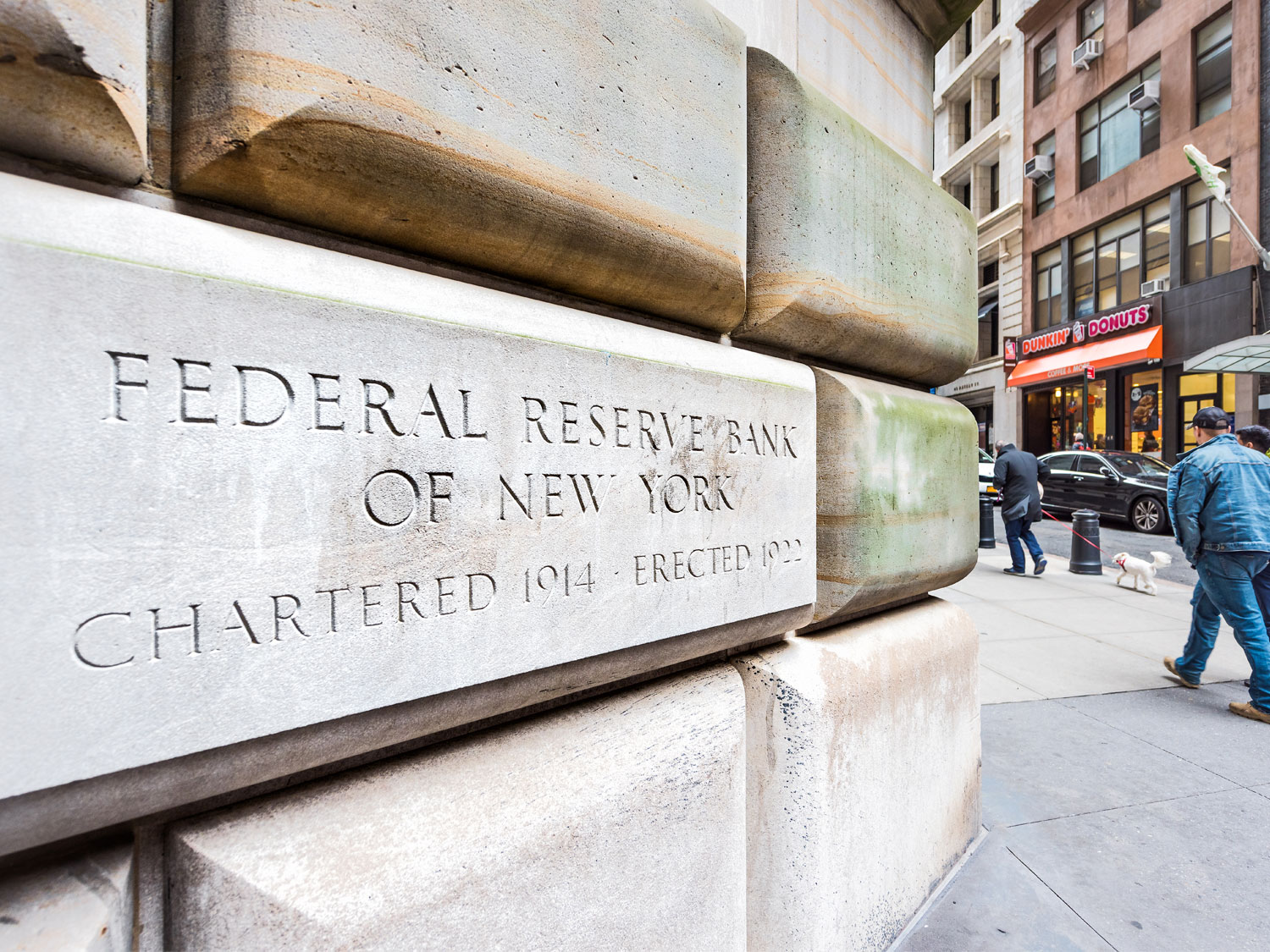
The Global Supply Chain Pressure Index (GSCPI), from Federal Reserve Bank of New York, uses data from shipping, purchasing managers' index surveys and manufacturing to chart disruption across the globe. 

The index is down 57% in July from its peak, with businesses in most large economies reporting an easing in delivery times of inputs and materials in July and a lack of materials and equipment is no longer a factor limiting production for Europe-based manufacturers.

Supply chain pressures were so serious that businesses were stopping production and shortages meant prices were shooting up, but now that goods can get to where they need to be, the system of international trade is dynamic and can recover.

Many hope to see pressures ease further in the coming months, but the impact of the Felixstowe strike and other current disputes have yet to be analysed by the index.

On the face of it, any spot of calm amid wave after wave of geopolitical turmoil should be a good thing for the world economy.

However, the trend may just reflect weakening demand for goods, as high inflation, which has, in part, been driven by the surge in the cost of shipping and materials since 2020.

The purchasing managers’ index (PMI) polls for July reported falling orders and a drop in backlogs, which is further evidence that weaker demand is opening up some spare capacity and allowing supply conditions to improve.

Many, though sadly not all, logistics hubs, ports and airports have adapted to the strains placed on them and are now able to process cargo more efficiently, by better managing the capacity they do have.

Nor is it just China’s wrangling with Taiwan and its disruption to commercial shipping that is cause for concern. There’s also Beijing’s insistence that its zero Covid stance remains the best strategy — a policy that has already led to multiple port and factory closures.

We may have taken a step forward, but disruptions are likely to be with us, for months and maybe years.

Global Supply Chain Pressure Index (GSCPI)

With fluctuating supply chain challenges around the globe, we work closely with our offices and network partners to monitor evolving situations and find solutions for our customers, including the most time-sensitive and urgent shipments. 

For the latest market insights and to review your supply chain situation please contact Elliot Carlile, who will outline how we can protect your supply chain in these volatile times.

If you would like to receive our regular market intelligence updates covering all things logistics please call Elliot Carlile and we will ensure that you receive this once issued.

Union Pacific

Supply chain disruption may soak up sea freight capacity on major Asian container trades

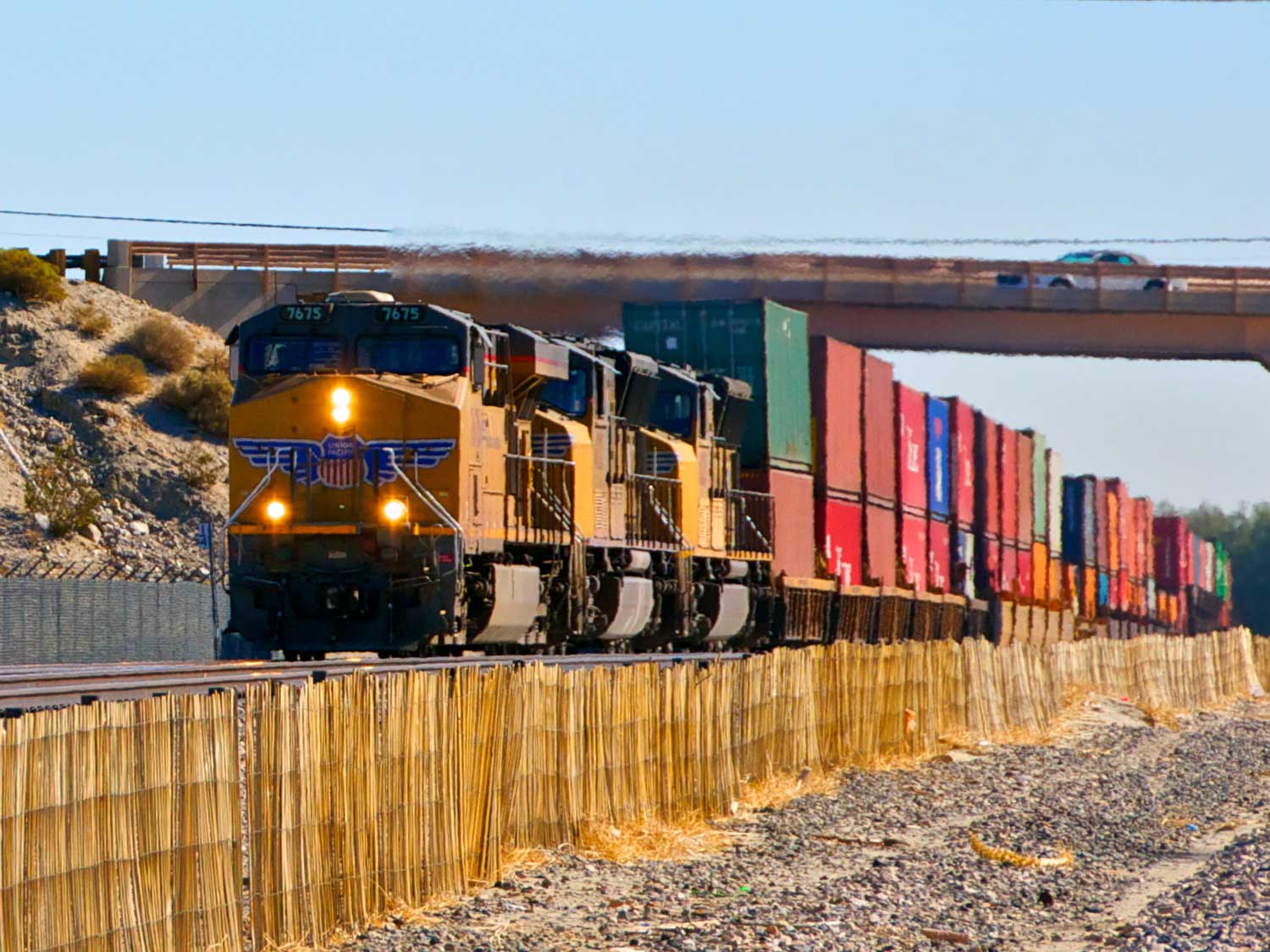
Capacity from Asia to the West Coast will be 20% higher through September, than last year, but inland supply chain disruption is continuing and threatens to wipe out any benefit from the increased capacity.

Carriers serving the US West Coast will have 20% more peak-season capacity from Asia, compared to the same period in 2021, by the first week of October and we are watching developments closely, as what transpires on trans-Pacific routes tends to be mirrored on the European lanes within weeks. The trades are thoroughly interlinked with trends and how they operate, quite often one event on the route effecting the other routes from Asia to Europe.

Despite the ability of Los Angeles/Long Beach to process boxes from ship to shore, the uplift in capacity may be significantly diminished, because there are insufficient railcar assets at terminals to bulk move containers away from the ports. Container dwell times at the West Coast ports shot up to a record 13.3 days in June, when the average dwell time should be no more than three to four days to prevent stacked containers from compromising operations.

A fortnight ago Long Beach had 12,650 rail containers on dock, while Los Angeles had 31,186, of which 23,880 were sitting on the terminals for nine days or longer, when there should be none.

Chassis providers complain that shippers are taking twice as long to release marine chassis, compared with pre-pandemic, while other shippers are simply leaving import containers in rail and marine terminals because they have inventory clogging their warehouses.

Much of the blame for the current situation is being laid on the biggest retailers, who are not keen on taking in more inventory amid slowing sales, because they do not have available storage space, which means backlogs build back from their warehouse doors, through the inland transport ecosystem.

In other developments, despite the Ocean Shipping Reform Act of 2022 becoming law in mid-June, to provide oversight of container storage fees and revised rules on loading exports, calls are growing to end the antitrust immunity currently enjoyed by container lines. 

The lines warn that the benefits of more services to more places, delivered more efficiently, would be undermined if legal certainty for operational agreements were removed. FMC chairman, Daniel Maffei, has floated the idea of increased monitoring of alliances and has also warned that shippers would suffer without the vessel-sharing agreements.

The International Longshoremen’s Association has also voiced support of vessel-sharing agreements because they provide more frequent service at a lower cost, which includes calls at small and medium-sized ports, that would no otherwise be served.

The ILWU and marine terminal employers have reached a tentative deal on health benefits for West Coast dockworkers, which is a positive move towards an overall agreement on a new labour contract.

Sources close to the negotiations believe that the likelihood is growing that a deal will be reached in August or September with little disruption occurring on the docks.

It is interesting to observe the North American markets as often many of these situations are emulated in The UK and Europe a few weeks later. Due to the shorter quay to quay transit times on the Transpacific routes its acts as a barometer on the Asia/ Europe trade so it is well worth following the market in USA and Canada and Americas as a whole as they are as significant in Boston in Lincolnshire as they are in Boston in Massachusetts.

We are working closely with our offices and network partners in North America to monitor these developing situations, set up contingency platforms and ensure product is delivered to market, without delay, however the peak season develops. 

Our services continue to be among the most reliable in the market, thanks to our fixed validity contracts and access to our own dedicated fleet of vessels to further enhance access to container slots.
 
Contact Elliot Carlile to learn more about our US capabilities, or to discuss your supply chain requirements, as we enter peak season, so that we can ensure you are prepared for the increased market activity.