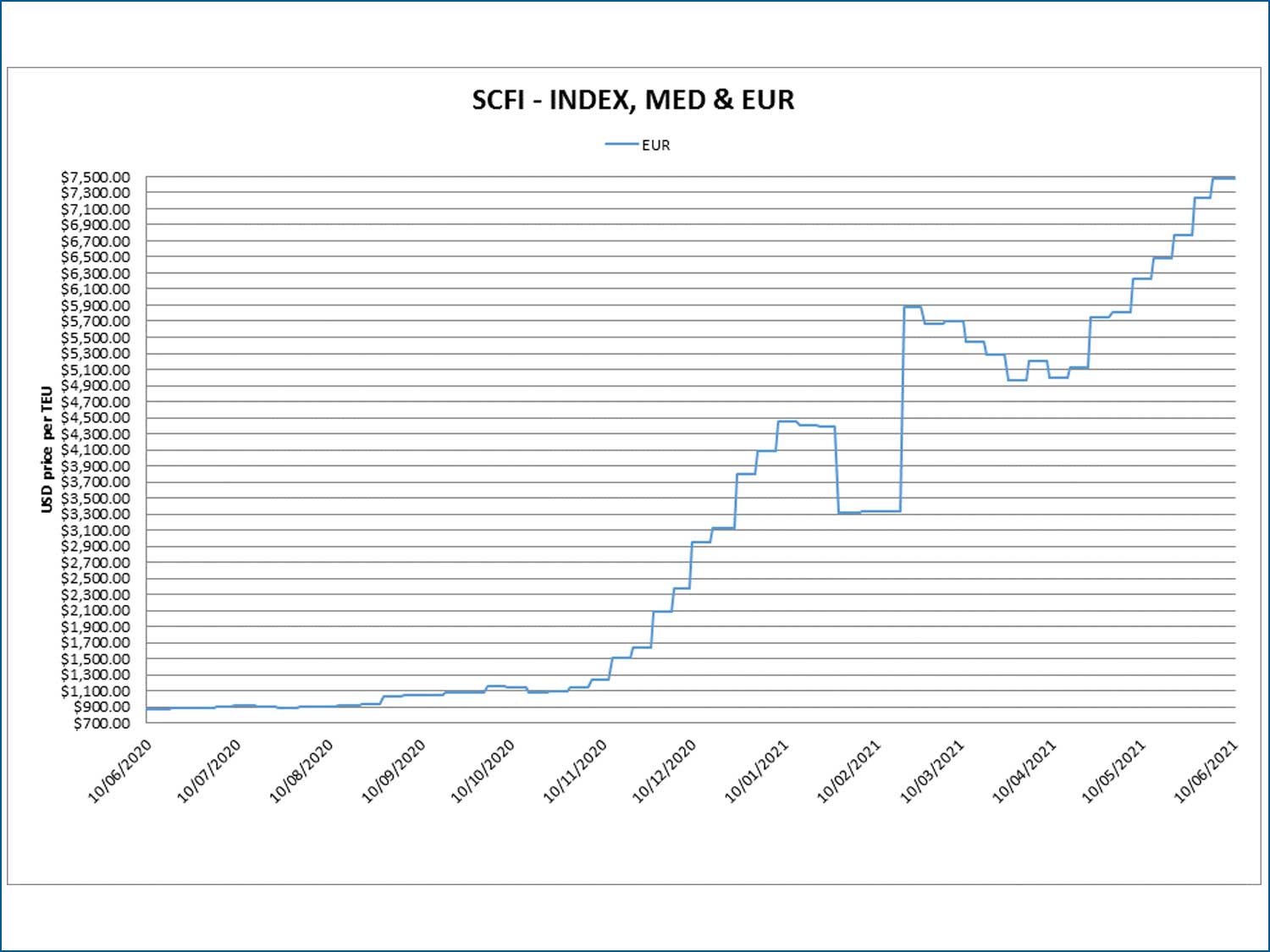
SCFI 10 06

Sea freight rates continue rise

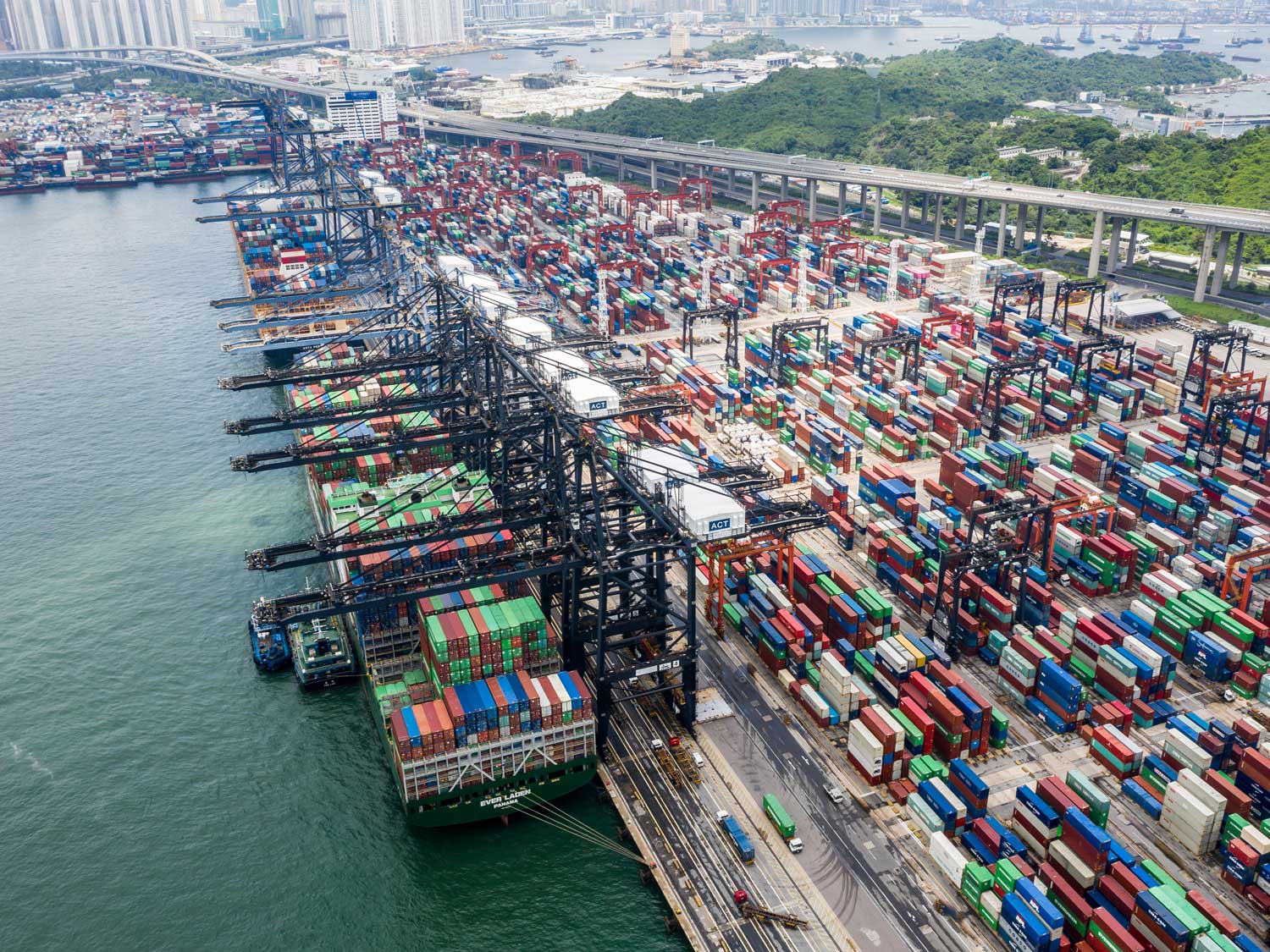
Monitored ocean Freight all Kinds (FAK) rates rose yet again this week from their already record-high levels, across all major East-West trades, up 518% on their level a year ago into Northern Europe and expected to remain on the higher side due to port congestion, huge demand and lack of equipment availability.

Shippers from Asia are bracing for imminent General Rate Increases (GRIs), and demand and capacity constraints mean that transatlantic shippers are also likely to see GRI premiums on top of elevated rates to secure space. This situation is actually being emulated in most regions globally and is not localised to Europe and the UK, as the carriers select the most lucrative routes and lanes to deploy their assets.

The impact of the market’s inflated pricing means that a number of critical commodities such as furniture and large electrical and electronic appliances risk being ‘priced out’ of ocean freight access to international vendors and factories. And that’s without the global consumer demand leading to inflation on many products and resources creating short supply of products, components and raw materials.

Research by Sea Intelligence suggested that one of the worst impacted cargo commodities is assembled furniture, where the freight rate now accounts for up to 62% of the retail value of the goods, and appliances, where the freight spot rate now accounts for up to 41% of the retail value for large appliances and up to 27% of the retail value for small appliances.

Some smaller businesses are struggling with the current supply chain disruption or simply being priced out of landing their goods and materials. Items like camping equipment have seen a spike in demand as families look to domestic holidays, but since many products are manufactured in China, there are shortages in the supply chains. As advised last week China is now the UK’s largest import trading region by some way with reliance, it would seem, on products that are fabricated and emanating from ‘the worlds factory’.

One outdoor equipment retailer is still waiting on orders placed in October and has nine containers of outdoor clothing, camping gear and hiking equipment stuck in Egypt as a result of the Suez Canal blockage.

It is very clear that we are now at a point where an increasing range of cargo commodity owners will struggle to maintain margins that will sustain their business, at the currently high freight rates.

Difficult choices need to be made in passing the elevated costs on to consumers, or waiting for rates to cool down, with the ever-present risk of losing business. Inflation looks set to continue to increase and not just a result of the cost of freight, although freight inflation of costs rise is likely to be unstoppable in the short term.

Rates keep climbing because demand and volumes have continued to stay at peak levels, and the delays that those volumes have created, in turn reduce capacity by tying up ships and containers at congested ports. This is all before the ‘traditional’ peak season expected in Q3/Q4 are factored into the supply chain equation.

So far this year carriers have cancelled the same percentage of Asia-US West Coast sailings due to delays, as they did last year because of plummeting demand during the first months of the pandemic.

Metro negotiate rate and volume agreements with a wide range of carriers across all three alliances, which means we can access the widest pool of equipment and offer shippers the biggest range of service offerings, port-pairings and rates.

Our fixed validity contracts provide supply chain security and peace of mind, but with space and equipment in such short supply, we recommend a minimum of four weeks visibility and booking window, to secure space on the vessel and get the right equipment positioned.

Please contact Elliot Carlile or Grant Liddell to learn how we can support your supply chains, even in the most challenging market conditions.
plane climbing

Air freight rates show no sign of softening despite dip in demand in May

Current supply and demand dynamics will maintain elevated prices through peak season and into 2022, with analysts predicting systemic market changes that will keep rates at an elevated level in the long term.

The rate of air freight rate growth has slowed on many routes, since peaking at the beginning of May, but rates remain exceptionally high, particularly from Asia.

The effective grounding of the world’s passenger aircraft fleet and the significant removal of much of the related bellyhold space, cut global air cargo capacity by 55% in a single stroke last year.

Lack of bellyhold capacity is still an issue, as slow vaccine rollouts and resurgent COVID variants have kept a lid on passenger numbers recovering. As well as government travel bans globally making it illegal and impossible.

Business travel is also stymied, which is normally a huge contributor to airline income and margins, especially on longer haul flights and it may be that airlines will not be in a financial position to recommission their fleets for some considerable time, particularly as any recovery is likely to miss major tourist seasons and thus any incentive to put more aircraft in the air in the short-term will be less. 

In a further twist Boeing is predicting that the global air fleet will grow by 3.2% annually over the coming 20 years, while cargo demand is expected to increase by around 4% each year over that same time, meaning that available belly freight capacity will fall and suggests that the low freight rates seen in the ten years previous to 2020 may have come to an end.

Consumer driven demand for goods has remained at the highest levels since Q3 2020 and shows no signs of abating, even as we enter what should be the traditional air freight summer lull.

Consumption remains high, inventories low, and supply chain disruption keeping inventories under pressure, with industrial goods, building materials, semiconductors and electronics equipment all in short supply due to breakdowns and delays in the supply chain. This is without considerations of the turmoil and impact of the ocean freight container market woes that are being experienced on a scale unprecedented in history, creating unimaginable delays on products destined for global markets.

The expectation that consumers would pivot from goods to services, leading to slower freight growth in the second half of 2021 is unlikely now, particularly as foreign-holidays and other travel are doubtful, leaving elevated savings intact and available to be disposed of in other ways.

Normal channels of distribution are facing severe backlogs, and shippers with high value or time sensitive goods are struggling to find solutions. Even creative service options, like trucking to inland airports, or moving via tertiary ocean ports are now not always viable. 

With so many shippers prepared to pay ‘whatever it takes’ to move their product, the current supply and demand trends are very likely to push elevated rates through peak season and into 2022, and possibly beyond. 

However there is one positive this week with Birmingham Airport becoming the focus for additional flights and cargo capacity – See the Loadstar article "More time-critical air services could answer prayers of ocean-shy shippers"

The addition of capacity in the form of China Airlines and Cathay Pacific flights returning after quarantine restrictions, may have contributed to a modest decline in Asia-US and Europe prices last week.

We work closely with leading airlines, cargo carriers and key hub partners to offer the widest range of time-sensitive solutions, routes and transit times, at the most competitive rates available in the current market. 

If you have urgent or time sensitive consignments and would like to explore options, transits and costs, please contact Elliot Carlile or Grant Liddell for all options available to ensure that deadlines are always met.

Yantian 3

Yantian port disruption widens with global ripple effects

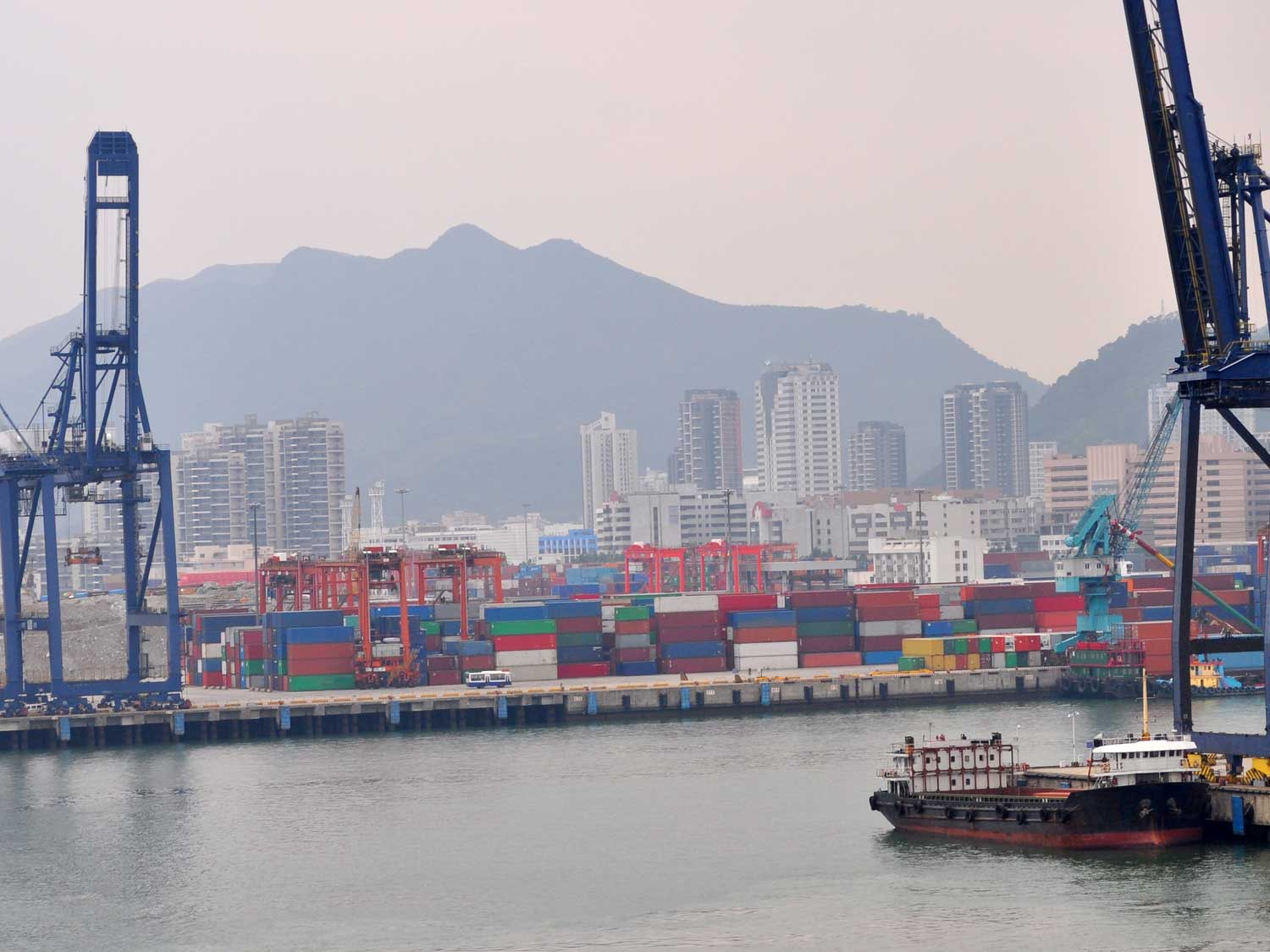
While some container shipping lines will continue calling at Yantian, other carriers have already diverted ships as the port’s operations have deteriorated, with Maersk warning that delays are now expected to last two weeks.

The Yantian congestion is yet another disruption to global shipping still reeling from the impact of the Suez Canal blocking in late March and the record surge of imports from Asia that has caused port congestion across Asia, the US, and Europe. This is again a localised issue that is creating a global impact and concern that will take months to recover with the ensuing fallout.

The closure of the three-berth west terminal is causing significant disruption with “increased congestion and vessel delays upwards of 14 days expected in Yantian port,” Maersk said in a customer advisory.

It is not yet clear when the west terminal at Yantian will reopen, while the east terminal (which handles the deep-sea container ships) is operating at 30% of normal productivity as dock workers remain quarantined or work in smaller teams.

All terminals are enforcing strict booking windows for laden containers and there are substantial traffic jams resulting from traffic control measures, that are also impacting trucking capacity.

Maersk, MSC, CMA CGM, and Ocean Network Express (ONE) are omitting scheduled calls at Yantian through the end of June and carriers are diverting some sailings to Shekou in western Shenzhen and Nansha, about 90 miles west of Yantian.

Laden export containers at Shekou, Chiwan, and Mawan will only be accepted up to three days before vessel departure from the 6th to 13th of June and Yantian has imposed a similar three-day cutoff during the same period.

Yantian
  • Operating with limited capacity
  • Yard density remains elevated with disinfection and quarantine measures
  • Congestion and vessel delays upwards of 14 days are expected
  • Trucking service into YICT must be reserved in advance
  • Covid test with green health codes required for drivers to enter the terminal
  • Only accept laden export containers with a vessel ETA of three days
  • Terminal workforce reduced by 70% following quarantine restrictions and testing

Nansha
  • Diverted vessels and containers creating congestion
  • New restrictions reducing access for transport
  • Traffic congestion building
  • Up to several days wait for container pick-up and laden container gate-in
  • Negative Covid tests required for truck drivers to enter the terminal

Shekou
  • Several carriers announced that vessels would omit the terminal
  • 6th of June till 13th of June, export laden container gate-in will be accepted only 3 days prior to vessel ETA

While the congestion continues at Yantian and other South China ports, we will continue to do everything we can to mitigate its impact and provide alternative solutions where it is appropriate or necessary. 

The key to strategic planning is visibility. Please continue to send your three month forecasts of movements to ensure we can manage your cargo flows and business expectations.

If you have any questions, concerns, or would like any further information regarding the situation in Yantian, please don’t hesitate to contact Elliot Carlile or Grant Liddell.

We are always transparent and candid in providing full visibility of the realities of the global logistics market, that will have an impact on our customers supply chains. Please call, email or text to arrange an immediate market update meeting, and soon face to face visit, from your Metro colleagues and account manager.

HKG port

China to UK shipping; worst transits ever, at highest ever cost – and that’s a fact!

If this was a typical year, we’d be approaching the start of the peak season for sea freight and the shipping lines would be preparing a round of general rate increases (GRI), but this year is anything but typical and even with demand soaring way beyond any typical peak period and freight rates already at their highest ever levels, carriers are still preparing more GRI’s, PSS’s and other surcharges.

The lingering effects of the Suez blockage, consistently high levels of global demand (on pretty much every trade lane) delays, disruptions, and limited availability of equipment drove a 9% increase on east-west transpacific container freight rates last week and prices are climbing everywhere.

Negotiations with shipping lines, across the alliances, are inevitably one-sided and, even when contracts are signed, the potential of rolled cargo and broken agreements is increased, as carriers are tempted to take advantage of massively lucrative spot rates on the ‘FAK’ market.

We leverage relationships, built over 40 years, with our primary carrier partners to maintain contract integrity but, inevitably, we have to often overcome the same challenges as our peers, to protect our customers and offer the realistic solutions that are available in the current market of the day.

Some shippers, desperate for space, continue to pay much more than the headline rates, as carriers levy extra charges such as space guarantees, which can easily reach $1,000 per box. This is in addition to the elevated market driven freight rates.

We have seen shippers in the market over recent weeks, with critical deadlines, paying over $13,000 for a 40ft high-cube from China to the UK and it is likely we will reach $15,000 this week. And continue to climb higher…..

Despite schedule reliability hitting record lows on multiple occasions this year, causing immense operational challenges and additional cost, the carriers are insistent on raising prices even further and that’s with Asia-Europe transit times deteriorating dramatically over the past three years, with Yantian, Shanghai and Ningbo increasing an average of nine days since 2018 as illustrated in the table.

When shippers are forced to cancel orders because the freight rates exceed their margins, it is plain that freight rates are too excessive and will result in business failures, at a time when economies need growth. There are and will continue to be increases in consumer product costs and inflation is now inevitable, based purely on the cost of moving product from factories.

And while the transpacific and transatlantic might have been relatively calm over the last week, in terms of price movements, we are expecting to see a new raft of general rate increases on those trades, and spot rates could soar once more, in part to demand and consumer appetite for goods and in part to the actual cost of moving those goods to where they are being sold.

Transatlantic carriers are reportedly preparing a new set of GRIs and/or peak season surcharges, ranging from $500-$2,500 per teu.

Carriers have yet to communicate their GRI expectations on the Asia - North Europe trade, but Hapag-Lloyd are indicating a $3,000 per 40’ GRI on Far East-US trades from mid-June, and with demand in their favour, it is likely they will achieve the increase. These numbers are at eye-popping levels that cannot be sustainable over the longer term.

As more equipment and capacity is introduced, it’s possible we’ll see some relaxation in rates, but with nations, globally, gradually emerging from the pandemic driving demand, which is currently pressured further by carriers blanking sailings to manage capacity, it’s difficult to see the prospect of rates softening anytime soon. This is without the global port congestion, shortage of empty equipment/containers at origins where needed and delayed schedules being considered.

Metro negotiate rate and volume agreements with a wide range of carriers across all three alliances, which means we can access the widest pool of equipment and offer shippers the biggest range of service offerings, port-pairings and rates.

Our fixed validity contracts provide supply chain security and peace of mind, but the best contracts cannot magic empty equipment, which is why we request a minimum of four weeks visibility and booking window, to secure space on the vessel and get the right equipment positioned.

Please contact Elliot Carlile or Grant Liddell to learn how we can support your supply chains, even in the most challenging market conditions.